
Financial Commission to Manage Stock Market Volatility with Sidecars and High-Frequency Trading Checks

 Prefer us on Google
The Korea Financial Research Institute held a seminar on the economic and financial outlook for 2027 on the 10th. The second session focused on financial markets. From left: Shin Yong-sang, Senior Research Fellow at the Korea Financial Research Institute; Kim Nam-jong, Head of Capital Market Research; Ko Young-ho, Director of Capital Market at the Financial Commission; Lee In-wook, Director of Market Analysis at the Financial Commission; Lee Hyuk-jun, Head of Corporate Evaluation at NICE Credit Rating; Lee Jin-woo, Head of Research at Meritz Securities; Yoo Jong-woo, Head of Research at Korea Investment & Securities. Source: Park Beom-soo/Digital Asset
The Financial Commission is adding stock market volatility management as a new pillar of capital market policy and will check the market impacts of sidecars and high-frequency trading (HFT). They will also examine the implementation of self-regulation related to margin loans while promoting institutional improvements to enhance the value of low PBR (price-to-book ratio) companies.
Ko Young-ho, Director of Capital Market at the Financial Commission, stated at the financial market outlook seminar on the 10th, "We are not setting the index level itself as a policy goal, but we are very concerned about volatility." He explained that existing capital market policies have been pursued around four goals: trust, shareholder value, innovation, and market accessibility, adding that "recently, we see that a new pillar has emerged in terms of volatility management."
Director Ko explained that the temporary measure announced last week to exempt the 140% collateral maintenance ratio for margin loans for three months was a proactive step to stabilize market sentiment. He continued, "We are conducting self-regulation to ensure that the margin loan proportion for specific stocks does not exceed 15%, and the total credit limit has been self-resolved at 90% of equity capital." The Financial Commission plans to check whether the related self-regulations are being properly implemented.
Director Ko noted that there is ongoing academic debate about whether high-frequency trading expands market volatility. He stated that as high-frequency trading expands with technological advancements, they will look into its market impacts and seek improvement measures. Regarding sidecars, he mentioned, "We are also examining the utility of sidecars," and explained that they are investigating whether sidecars might inadvertently increase volatility due to the learning effects of market participants.
He also mentioned legislative discussions to expand the authorities' powers over financial investment products. Director Ko explained that while there are powers over financial investment firms, there is a lack of explicit powers over products. He expressed hope that if relevant provisions are discussed in the National Assembly, the financial authorities will secure additional means to manage the market.
In the medium to long term, they plan to continue institutional improvements to enhance the value of low PBR companies. Director Ko mentioned the need for amendments to inheritance and gift tax laws to prevent stock price suppression and the establishment of fair value assessment systems for merger prices. He also introduced the fact that 151 low PBR companies were announced on the 2nd and that they are examining overseas cases of the 5% rule for large holdings reporting systems to promote mergers and acquisitions (M&A). He emphasized, "We must manage volatility and improve the system simultaneously," and reiterated that the government will continue to push necessary measures for the market.
On the same day, Kim Nam-jong, Head of Capital Market Research at the Korea Financial Research Institute, projected that the stock market would experience uncertainty until the first half of 2027 but stabilize in the second half based on corporate profits. He analyzed that while the semiconductor sector led the market with profit increases and stock price rises this year, disparities between sectors, foreign selling, and leveraged investments have expanded volatility. He believes that the sustainability of the AI and semiconductor cycles and the recovery of foreign demand will be key variables for the financial market next year.
Yoo Jong-woo, Head of Research at Korea Investment & Securities, presented a KOSPI forecast of 8,280 points for 2027, based on a rebound in Samsung Electronics and SK Hynix stock prices. He explained that profits in sectors other than semiconductors are also increasing, suggesting that next year may see stock price rises across a wider range of sectors compared to this year. However, he raised the possibility of falling memory semiconductor prices in the second half of next year, analyzing that such changes in the business environment may have already been largely reflected in stock prices.
Lee Jin-woo, Head of Research at Meritz Securities, proposed a scenario where the KOSPI recovers to around 8,700 points in the first half of 2027. He diagnosed that the core of the current stock market adjustment is skepticism about the sustainability of profits in the AI industry. He analyzed that bottlenecks in funding have emerged after semiconductor supply and energy in the AI investment process. He projected that whether the AI investment cycle centered on inter-company transactions expands into the consumer market in the second half of next year will be an additional variable for upward movement.
Lee Hyuk-jun, Head of Corporate Evaluation at NICE Credit Rating, expressed concerns about excessive capital concentration on large semiconductor stocks and the increasing short-term funding dependence of companies. He explained that the stock issuance amount from January to September this year was about 5.3 trillion KRW, a decrease of approximately 49% compared to the same period last year, and that the net issuance of general corporate bonds recorded a negative 15 trillion KRW. In contrast, he noted that the issuance of CP and short-term bonds increased by 51% to 1,780 trillion KRW. He argued that there is a need to reassess the results of productive financial policies and emphasized that investments should be expanded to other quality companies beyond Samsung Electronics and SK Hynix, and that the corporate bond market should be revitalized.
Lee In-wook, Director of Market Analysis at the Financial Commission, analyzed that the cash flow of semiconductor companies affects not only the stock market but also the short-term financial market and the foreign currency funding market. He explained that while risks were previously assessed focusing on capital concentration, leverage, and interconnectivity among financial institutions, it is now necessary to examine how the funds of general industries and companies impact the financial market and financial industry. He stated that as the scale and influence of the financial market have expanded, they are also reviewing the appropriateness of the existing market monitoring system and the stability programs for corporate bonds and bond markets.
This content is provided for general informational purposes only and doesn't constitute financial, investment, legal, or tax advice. Any events, rewards, online promotions, or related information mentioned herein should not be considered a recommendation, solicitation, or invitation to purchase, sell, trade, or otherwise deal in any crypto assets. Crypto assets are highly volatile and may result in loss. The availability of WEEX services, products, and related events may vary by region. You are responsible for ensuring that your participation is in accordance with applicable local laws and regulations.
You may also like

WEEX P2P now supports ILS, BHD, OMR & QAR —Merchant Recruitment Now Open

Why Doesn't Bitcoin Always Rise When Stocks Rally?
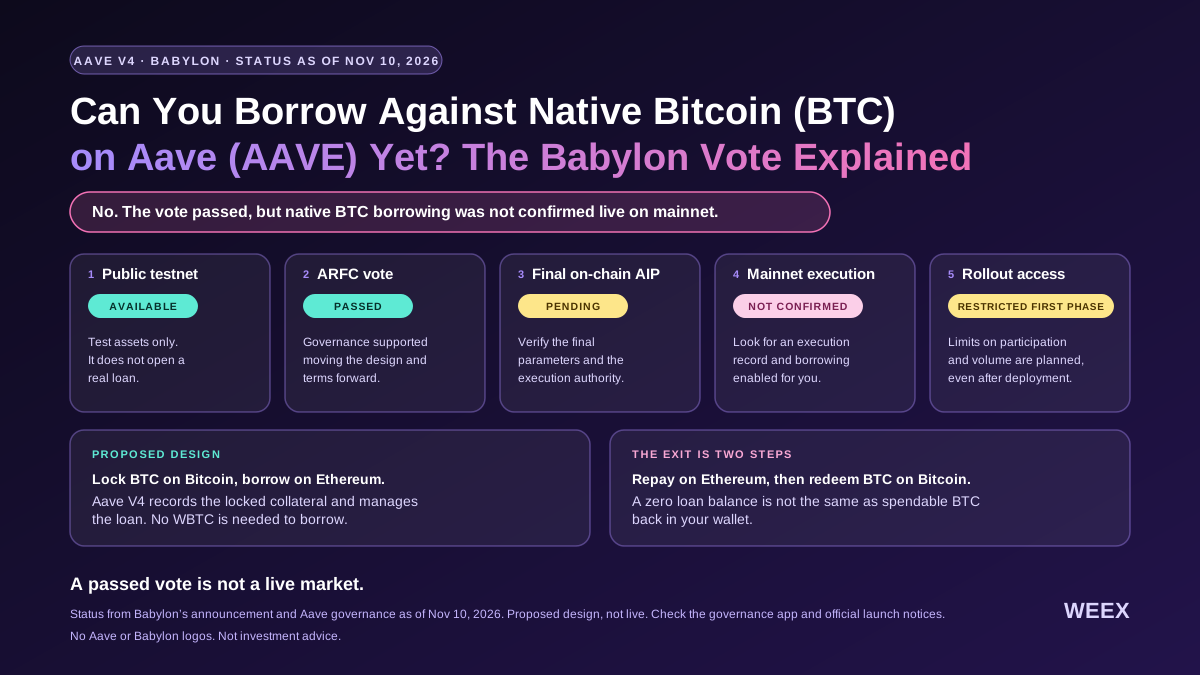
Can You Borrow Against Native Bitcoin (BTC) on Aave (AAVE) Yet? The Babylon Vote Explained
Can you borrow against native Bitcoin on Aave yet? See what the Babylon vote approved, what still needs to launch, and how BTC liquidation would work.

IMF urges Kenya to make crypto firms share customer data under Travel Rule
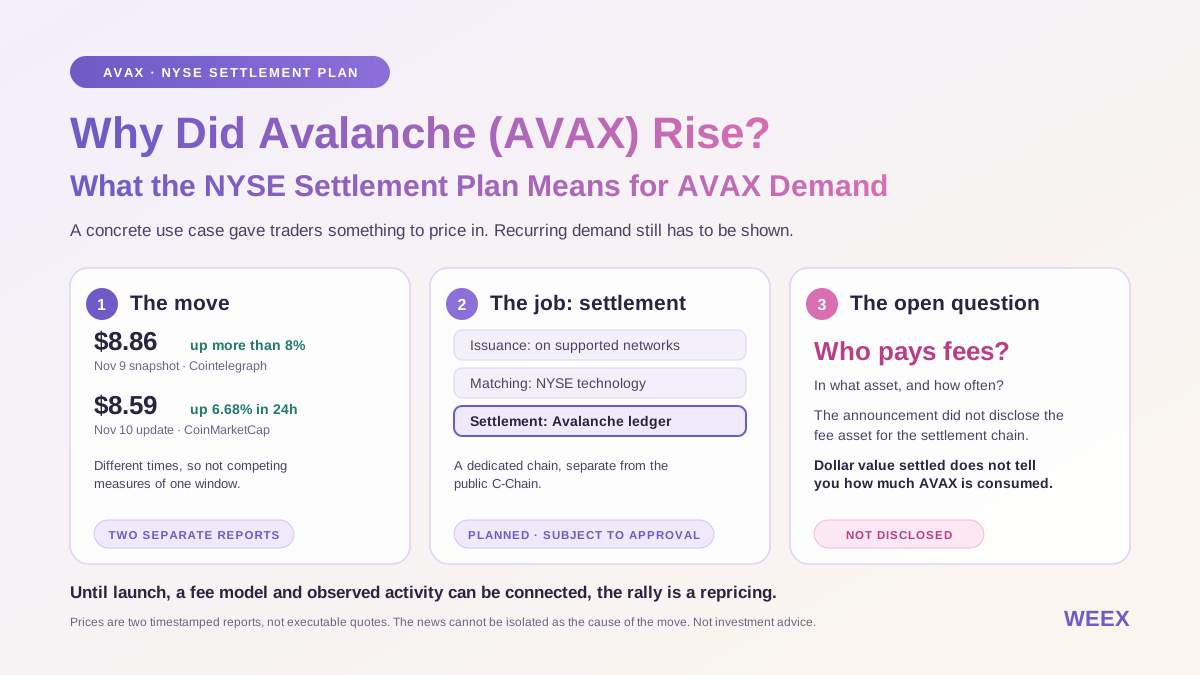
Why Did Avalanche (AVAX) Rise? What the NYSE Settlement Plan Means for AVAX Demand
See why Avalanche (AVAX) rallied after the NYSE settlement announcement, how the dedicated chain would work, and what could create demand for AVAX.

Kim & Chang Lawyer: "Excessive Responsibility Should Not Be Imposed on Stablecoin Issuers"

Cryptocurrency Security Checklist: Four Lessons from Phemex Safety Hub Vol. 05–08

Solana's Former DEX Leader Prepares to Go All In on US Stocks

Unauthorized Access to Gnosis Pay's Old Card System Leads to Customer Data Breach

Alchemy Pay Says Mississippi Licence Expands US Money Transmission Coverage to 20 States

Hong Kong Approves Crypto Asset Reporting Rules - Fintech World

Biden's Son's LAPTOP Burns 5.5% as Conditions Met in U.S. Midterm Elections

TRON surpasses 413 million accounts, but what do network stats show?

Countdown to the GENIUS Act: Only USDC and PYUSD Pass Among the Top Ten Dollar Stablecoins

NVDA Stock Falls 4.3% After Board Opens Investigation: What Is Confirmed and What Is Not
NVDA closed at $178.67 on November 9, 2026, down about 4.3%, after Nvidia’s board confirmed an independent investigation. Other claims come from media reports. WEEX’s Lucky Eggs campaign runs until November 25.

How to Resolve Data Center Controversies? This U.S. State Wants to Tokenize Computing Power to Share Benefits with Residents

Lombard Systems Raises $4M to Make Tokenized Assets Easier to Borrow Against

When is the launch date of Bitcoin Hyper? Testnet, tokens, and mainnet are separate milestones

Westpac's Cryptocurrency Payment Limit (A$10,000): What Changes on December 1, 2026
Ethereum’s new P2P protocol doubles block delivery speed, Optimum says

Middle East Easing Expectations Boost Stocks | WEEX Daily Brief (November 10, 2026)
On November 9 close, the S&P 500 and Dow both rose more than 2%. Middle East easing expectations pushed oil prices lower. Bitcoin and Ethereum spot ETFs saw net outflows last week. AVAX rose on reports of tokenized-stock clearing. PIEVERSE surged short-term. November 10 focus is October CPI, TSMC monthly sales data, CoreWeave earnings and others.

Chainalysis Report: Why Did Western Europe Withstand the Global Crypto Market Chill?

Blockchain.com Adds Trading API for Institutional Crypto Execution

The "Monopolist" Behind $4.6 Billion Tokenized U.S. Stocks: 91% of Assets Are Custodied by the Same Company?

LNbits disables hosted Bitcoin services with no restart timeline
Ray Dalio Warns of Diminished Trust in U.S. Treasuries Amid Political Conflicts

Government Considers Expanding Domestic Communication Surveillance, Plans to Amend Active Cyber Defense Law; Financial Services Agency to Establish Cybersecurity Guidelines for Cryptocurrency Exchanges in April

BitPay Brings Apple Pay and Google Pay Checkout to Crypto Purchases

Circle moves USYC fund into longer-dated US Treasury bills

Four Security Strategies from the Wallet Theft Incident
WEEX P2P now supports ILS, BHD, OMR & QAR —Merchant Recruitment Now Open
Why Doesn't Bitcoin Always Rise When Stocks Rally?
Can You Borrow Against Native Bitcoin (BTC) on Aave (AAVE) Yet? The Babylon Vote Explained
Can you borrow against native Bitcoin on Aave yet? See what the Babylon vote approved, what still needs to launch, and how BTC liquidation would work.
IMF urges Kenya to make crypto firms share customer data under Travel Rule
Why Did Avalanche (AVAX) Rise? What the NYSE Settlement Plan Means for AVAX Demand
See why Avalanche (AVAX) rallied after the NYSE settlement announcement, how the dedicated chain would work, and what could create demand for AVAX.
Kim & Chang Lawyer: "Excessive Responsibility Should Not Be Imposed on Stablecoin Issuers"
Latest articles
Latest coin listings on WEEX


