
How to Resolve Data Center Controversies? This U.S. State Wants to Tokenize Computing Power to Share Benefits with Residents

 Prefer us on Google



Tokenizing computing power, a policy experiment in Alaska.
Written by: Emma Haidar, Bloomberg
Compiled by: Chopper, Foresight News
For a long time, Alaska has shared oil revenues with local residents. Now, the state's governor hopes to extend this model to the booming data center sector, utilizing blockchain technology to provide economic benefits to residents. However, due to the enormous energy demands of data centers, the industry is facing increasing opposition.
The state government plans to build a platform to arrange and track investments in data centers and energy projects, intending to open direct investment channels to ordinary Alaskans. This proposal aims to allow residents to share in the profits generated by data center development, although the specific structure and terms of the investment have yet to be finalized. Such securities offerings typically require registration with the U.S. Securities and Exchange Commission (SEC) or obtaining an exemption.
Alaska is collaborating with the infrastructure financing platform Plural to put investment contracts on the blockchain, which means tokenization, allowing transaction records to be digitally stored and tracked. The long-term goal is to enable ordinary Alaskans to directly invest in the state's data centers and energy projects.
Alaska Governor Mike Dunleavy stated, "I want to find a new way for ordinary people to participate in resource development. What we want to do in Alaska is to allow everyone to become a small capitalist and have the opportunity to share in the dividends."
Mike Dunleavy, Governor of Alaska
This model has been operating in Alaska's oil industry for over forty years. For many years, Alaskans have received dividends from the Permanent Fund Dividend program, which is also the reason most residents continue to support oil exploration in the state. This year, each eligible Alaskan resident will receive a dividend of $1,200.
Alaska officials have long promoted the state's ample land, cool climate, and natural resources such as natural gas and hydroelectric power as ideal for building data centers; however, the downside is a relatively dispersed power grid. Nonetheless, data center projects are still an emerging sector in the state, and related proposals have faced significant opposition from residents, mirroring resistance seen across the country.
Part of the Trans-Alaska Pipeline System and Dalton Highway in Alaska's North Slope
A proposed 3-gigawatt data center in Alaska's North Slope, which would consume as much electricity as 2.4 million households, has received a large amount of public opposition.
Democratic candidate Mary Peltola, leading in the federal Senate election, has set up a website criticizing incumbent Republican Senator Dan Sullivan for supporting data center projects. The website claims that large-scale construction of such infrastructure will drive up electricity prices, occupy public recreational land, and threaten fish and caribou populations.
Similar resistance voices have emerged across the country, with dozens of local measures introduced during this election cycle to restrict or halt data center construction. Texas, Georgia, and Ohio, which were once key investment areas for AI infrastructure, have newly elected Democratic governors who have proposed giving local communities a greater voice.
Mary Peltola
Alaska is likely to follow this path as well. Democratic candidate Jonathan Kreiss-Tomkins is leading significantly in the gubernatorial race and will succeed the term-limited Dunleavy. Kreiss-Tomkins has proposed pausing the approval of new data center projects until the state legislature establishes supporting regulatory rules and implements local approval rights.
Jonathan Kreiss-Tomkins
Kreiss-Tomkins' campaign spokesperson did not respond to inquiries regarding data center construction. Alaska plans to complete ballot counting by November 25, with the new governor being sworn in on December 7.
Tokenization is a way to open data center projects to a broader range of investors. Several Wall Street institutions have already adopted this approach, registering various assets such as stocks and bonds on distributed ledgers. Supporters argue that tokenization offers greater transparency, faster settlements, and supports round-the-clock trading; the scale of on-chain real asset management has also significantly increased.
The Dunleavy administration has also announced the establishment of Alaska Data, a subsidiary of the state’s economic development agency, specifically to attract private development funds for this plan. The state government plans to sell investment products to ordinary investors through a new entity called InvestNorth.
Although the plan aims to provide ordinary people with opportunities to invest in AI-related infrastructure, it also carries new risks. The proposal has yet to be implemented, and many issues such as liquidity and investor protection remain unresolved. Critics view this as essentially a speculative product aimed at high-risk AI infrastructure projects. Alaska is playing a dual role: promoting data center projects while issuing related investment products, which could put the state government in an awkward position if the projects ultimately incur losses.
However, Dunleavy believes that residents holding project shares can alleviate concerns about data centers. "If locals can become shareholders of the data centers and receive profits, the interests of the community and the projects can align."
Plural's CEO Adam Silver admits that while Wall Street is optimistic about the AI boom, ordinary people are wary of data centers, and this contradiction is real. "Our proposal directly addresses this contradiction. You can be a resident expressing concerns at the dinner table or an investor profiting from the project."
Brandon Brefczynski, president of Alaska Data and deputy director of the state’s economic development agency, believes that Alaska's push for tokenization is an advanced version of the oil Permanent Fund Dividend model. "It’s like taking a step forward, allowing Alaskans to directly invest in these projects."
Silver states that a significant advantage of tokenization is that Alaskans can clearly see the flow of funds within the state. "You can check the project’s performance in real-time, whether there are defaults, underperformance, or overachievement; all of it is on-chain and publicly visible."
Silver notes that about a year ago, the governor began to pay attention to the data center boom, and the two sides established contact. Developers are moving out of traditional concentrated areas like Northern Virginia's 'data center corridor,' and Alaska hopes to capture some of that investment.
Although his term is coming to an end, Dunleavy remains optimistic about this model. "This model will flourish across the United States in the future."
-- Price
This content is provided for general informational purposes only and doesn't constitute financial, investment, legal, or tax advice. Any events, rewards, online promotions, or related information mentioned herein should not be considered a recommendation, solicitation, or invitation to purchase, sell, trade, or otherwise deal in any crypto assets. Crypto assets are highly volatile and may result in loss. The availability of WEEX services, products, and related events may vary by region. You are responsible for ensuring that your participation is in accordance with applicable local laws and regulations.
You may also like
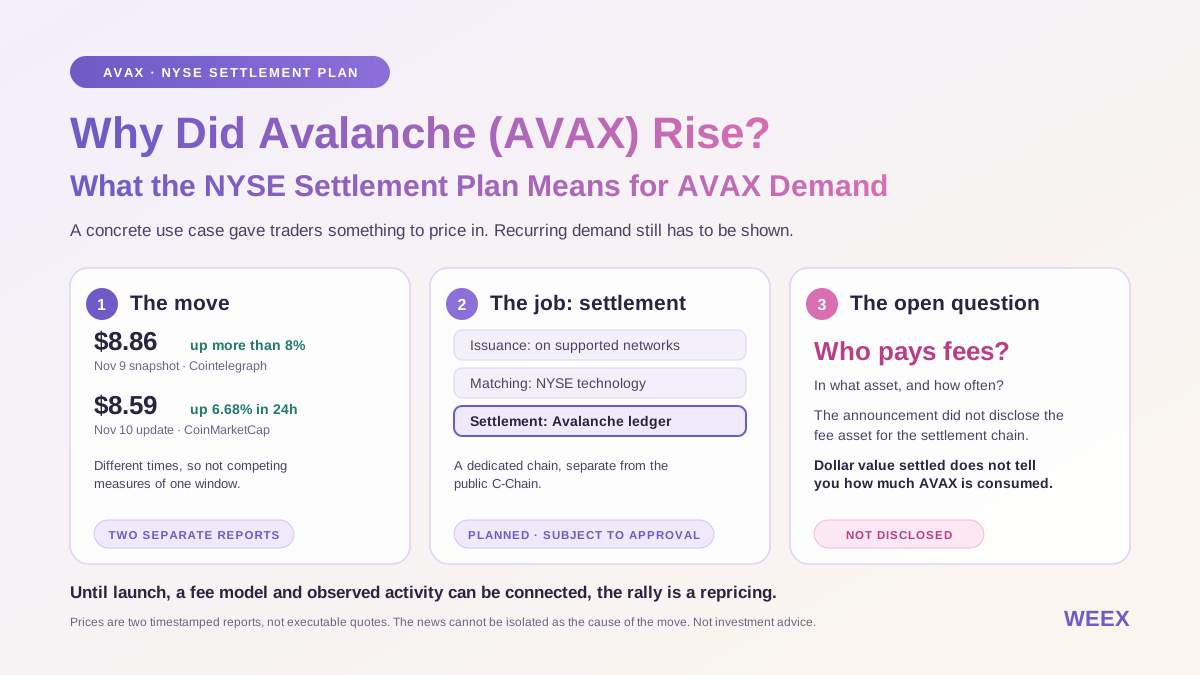
Why Did Avalanche (AVAX) Rise? What the NYSE Settlement Plan Means for AVAX Demand
See why Avalanche (AVAX) rallied after the NYSE settlement announcement, how the dedicated chain would work, and what could create demand for AVAX.

Wall Street Morning Briefing: Market Soars on Oil Prices and AI Recovery, Nvidia Falls Alone, Data Centers Become Political Regulation Focus, CPI Lacks Year-on-Year Comparison Adds Variables

Ethereum's 2028 Challenge: Quantum Resistance Roadmap Hits Release Bottleneck

Understanding the DEX 'Hyperliquid': A Practical Workshop|Japan Digital Economy Federation

Envision Star River Base Completed in One Year with 120MW Capacity at One-Fifth the Cost of Similar U.S. Projects

AI Data Centers Are Buying Used Jet Engines as New Power Turbines Take Six Years

Crypto: Ethereum Prepares Two Solutions to Protect Its Smart Contracts

Heating by Mining Bitcoin? Finnish Families Are Trying This 'Free' Heating

Elysium Mainnet Launches with Block Time of 100 Milliseconds and Arrival Time of Approximately 300 Milliseconds

Samsung Etching Process Formulas Flow to Lam Research Korea

Raycash Launches on Ethereum Mainnet, Offering Privacy Stablecoin Payments and Yield Features

South Korean Deputy Prime Minister Says AI Data Center Regulation Needs Observation After U.S. Midterm Elections

Ave.ai Supports Elysium Ecosystem, Opens Cross-Chain and On-Chain Trading Capabilities

Who Will Bear the Cost of Delays in AI Data Centers?

Ethereum Releases Gas Repricing EIP Draft

Ethereum Developers Call for Halt to Gelmsterdam Upgrade

Vitalik: High Intervention Governance Needed for Fee Burn, May Drive Up Gas Prices

Anthropic Acquires $3.4 Billion Gas Power Equipment

Google buys Crusoe's data center in Wyoming for $17 billion

EIP-8037 state-gas rules force Ethereum dApps to rewrite billing

Stablecoins offer sub-cent payments, Armstrong says, as critics flag risks

Democratic Party's AI Regulation Push Revealed: Plans for Intensive Legislation and Strict Scrutiny of Tech Giants

Ethereum Foundation Reminds Contract Developers to Self-Check Impact of Glamsterdam Gas Adjustments

Breaking Down Bitcoin Trends: What Determines the True Value of L1?

Yushu and PetroChina Jointly Establish Industrial Embodied Intelligence Company with Kunlun Manufacturing Holding 60%
ZetaChain Proposes L1 Shutdown Amid Solana Migration, Plans to Burn 55 Million ZETA
SemiAnalysis: Musk Breaks Through Again, How SpaceX Competes for the World's Largest AI Cloud?
What is Qtum (QTUM)? A Proof-of-Stake Smart Contract Chain

Important News from Last Night and This Morning (November 4 - November 5)

FERC Approves MARA's Acquisition of Long Ridge Natural Gas Power Plant
Why Did Avalanche (AVAX) Rise? What the NYSE Settlement Plan Means for AVAX Demand
See why Avalanche (AVAX) rallied after the NYSE settlement announcement, how the dedicated chain would work, and what could create demand for AVAX.
Wall Street Morning Briefing: Market Soars on Oil Prices and AI Recovery, Nvidia Falls Alone, Data Centers Become Political Regulation Focus, CPI Lacks Year-on-Year Comparison Adds Variables
Ethereum's 2028 Challenge: Quantum Resistance Roadmap Hits Release Bottleneck
Understanding the DEX 'Hyperliquid': A Practical Workshop|Japan Digital Economy Federation
Envision Star River Base Completed in One Year with 120MW Capacity at One-Fifth the Cost of Similar U.S. Projects
AI Data Centers Are Buying Used Jet Engines as New Power Turbines Take Six Years
Latest articles


Latest coin listings on WEEX


