
The Battle of Personal Agents: Ambition and Restraint

 Prefer us on Google



The domestic Personal Agent market welcomes a heavyweight player.
On November 24, Doubao's AI personal assistant product "Xiao Dou" officially launched its public beta. This product, which adopts an independent app format, emphasizes long-term memory, proactive service, and task execution capabilities, allowing users to delegate personal affairs that require long-term follow-up to AI.
Thus far, from Tencent's Xiaowei, Alibaba's Qianwen Go!, to Ant Group's Lingguang 2.0 and ByteDance's Xiao Dou, four major internet companies have launched their own Personal Agent products to the market.
Competition is heating up. A source close to Ant Group revealed to Wall Street Journal that Lingguang has already regarded Xiao Dou as a potential competitive pressure.
Interestingly, although the major companies have gradually reached a consensus on the direction of product evolution, they have chosen different implementation methods.
All-weather technology's experience found that although Xiao Dou and Doubao have integrated credit and memory, it still exists as an independent app; Ant Group has a mature super app in Alipay but has placed this exploration in the independent app Lingguang; Tencent has embedded Xiaowei into WeChat but retains certain data permissions.
In contrast, Alibaba, which directly embedded Qianwen Go! into the Qianwen app, has become a noteworthy exception.
The different product choices hint at the cautious mindset of internet giants in this competition.
In the AI competition over the past few years, major companies have feared not running fast enough, not having strong enough models, or not covering enough users.
However, at the Personal Agent stage, as AI begins to intervene more deeply in users' work and lives and attempts to reorganize various internet services, the factors that companies need to weigh have increased.
They are reluctant to miss the next super entry point, yet they also do not want to easily change the entry points they already possess.
Independent or Embedded
Despite appearing as an independent app, Xiao Dou does have certain connections with Doubao and others.
Specifically, for users who have previously used Doubao and Doubao Work, they can directly import the memories accumulated in these into Xiao Dou without reintroducing their professional background, work habits, and personal preferences; at the same time, the credit that users have recharged for Doubao can also be used for Xiao Dou.
Xiao Dou also provides multiple entry points for third-party applications, including Amap, Wind, Ziroom, Baidu Cloud, etc., covering scenarios such as finance, travel, living, and office work.
Doubao stated that in the future, the capabilities and experiences on Xiao Dou will gradually be launched on the Doubao app.
Although personal memories can be migrated and product capabilities will gradually flow back, Xiao Dou still appears as an independent app rather than being directly embedded into the Doubao app.
Coincidentally, Ant Group has also adopted a similar product strategy.
In October this year, Ant Group launched the independent Personal Agent Lingguang 2.0, which also has not been embedded into the super app Alipay.
In fact, even companies that choose to embed Personal Agents into existing super apps have reserved certain capabilities.
Among several internet giants, WeChat may be the most restrained one.
In June this year, WeChat began testing the Personal Agent "Xiaowei." However, Tencent did not grant Xiaowei the permissions to continuously read chat records or proactively accumulate personal memories simply because Xiaowei is WeChat's native AI assistant.
This restraint not only continues the product philosophy that Zhang Xiaolong has consistently emphasized but also reflects WeChat's realistic choice to control external risks as a national-level application when introducing new technologies.
After all, WeChat is no longer just a social software; it is deeply embedded in the work, life, and business activities of over a billion users. Every release of AI capabilities could potentially impact existing social relationships, user experiences, and even the business ecosystem.
For WeChat, the boundary of technical capabilities does not equate to the boundary of product capabilities. Defining what AI should do is equally important as showcasing what AI can do.
Overall, while the product forms differ, none of the three companies are eager to allow Personal Agents to fully intervene in the user entry points they have already mastered.
This is not common in the AI competition of the past few years. Previously, internet giants were keen to showcase the upper limits of their AI capabilities, but they have all maintained restraint regarding Personal Agents.
In contrast, Alibaba is an interesting exception.
Previously, Qianwen has gradually integrated with Alibaba's ecosystem businesses such as Taobao, Alipay, Taobao Flash Purchase, Fliggy, and Amap, enabling functions like shopping, ordering takeout, and booking flights. Qianwen Go! has further expanded its capabilities to help users check historical Taobao orders and apply for price protection refunds, communicate with customer service for flight delay compensation, and even inquire about car maintenance and make appointments.
Although Qianwen Go! also adopts a gradual opening of experience qualifications, at least in terms of product form, Alibaba has not isolated Personal Agents from existing AI products like ByteDance has.
However, this difference may be related to the development stages of the two products.
QuestMobile data shows that in September this year, Doubao and Qianwen App had monthly active user scales of 419 million and 158 million, respectively.
For Qianwen, directly introducing Qianwen Go! into the Qianwen App can further release the service capabilities accumulated from integrating with Alibaba's ecosystem and is expected to increase interaction frequency with users through functions like personal affairs management and proactive reminders, enhancing Qianwen's activity.
While developing Personal Agents, each company faces different operational propositions.
Alibaba needs to leverage new product capabilities to further cultivate Qianwen users' usage habits, while the other major companies need to consider more how new interaction methods impact existing user experiences.
In the past, the large stock of users has always been one of the most important chips for internet giants when developing new businesses.
However, at the Personal Agent stage, this chip has another side.
The larger the user scale and the more firmly established the product mindset, the more factors companies may need to weigh when promoting product changes.
The Restraint Behind
The restraint in product design may stem from two aspects.
One aspect is the cost of computing power.
Although both are AI applications, the cost structures of Agents and Chats differ significantly.
In the traditional AI assistant product form, users actively initiate conversations, and the model completes the answer, usually concluding a reasoning process. However, Personal Agents need to convert a single demand into a series of operations, involving task decomposition, tool invocation, result verification, and multiple links. For some affairs that require long-term follow-up, even if users do not open the app, new computing power consumption may still occur.
For example, when users delegate tasks like monitoring flight prices or tracking product price drops to AI, the latter may need to repeatedly search for information over the coming days or even months and make judgments based on changes in external information.
In the past, major companies could estimate reasoning costs through user activity, interaction frequency, and other indicators. However, at the Personal Agent stage, the number of tasks entrusted by users, the complexity of tasks, and execution frequency will all become variables affecting costs.
"Since the goal is to cover all WeChat users, the company needs to control costs, so it chooses to use a smaller model. Even if opened to all users, Xiaowei's costs will not be very high, and its quarterly costs will be lower than the quarterly costs of Yuanbao at the beginning of this year," Tencent President Liu Chiping stated at the third-quarter earnings conference.
This calculation is something even Meta needs to consider carefully.
On October 21 this year, Meta founder and CEO Mark Zuckerberg admitted at the third-quarter earnings conference that Muse still requires a large amount of computing power to operate at this stage. Meta expects that Muse's cost efficiency will improve by more than ten times in the coming year.
On the other hand, major companies also need to reassess the trust relationship with users.
In the past, AI assistants mainly worked within the range of information actively provided by users. However, for Personal Agents to truly achieve personalization and proactive service, they need to have a more comprehensive understanding of users and obtain permissions to invoke various apps and services.
For example, helping users arrange a trip may require understanding their schedules, geographical locations, and spending preferences, as well as invoking maps, hotel bookings, and even payment services.
For Personal Agents, the richer the information obtained and the more services that can be invoked, the greater the opportunity to complete complex tasks.
However, for users, being willing to use an app does not mean they are willing to hand over all the information accumulated in that app to AI. Especially for super apps like WeChat and Alipay, the trust users have built over the years is itself an important commercial asset.
Moreover, as AI moves from providing suggestions to autonomous execution, the consequences of errors also begin to change. In the past, if AI provided an incorrect answer, users could choose not to adopt it. But when AI can replace users in sending messages, modifying schedules, or completing transactions, a single erroneous judgment could have real-world consequences.
The scope of user authorization, the reversibility of operations, and the responsibility for errors in task execution all need to be clarified.
As early as the second-quarter earnings conference in August this year, Tencent revealed that it had actively limited some capabilities of Xiaowei.
"Although this prototype can technically handle advanced agent workflows, for safety reasons, we have configured Xiaowei to require user intervention and multiple confirmations at this time," Tencent's management stated at that time.
From this perspective, the independent app objectively provides ByteDance and Ant Group with a testing ground for new interaction methods, user authorization willingness, and business models, while Tencent needs to delineate the boundaries of capabilities and permissions more carefully within WeChat.
Expanding Territory and Defending Borders
Successfully developing Personal Agents does not solely depend on the technical capabilities of internet giants themselves.
Previously, Tencent Group's Senior Executive Vice President and CEO of Cloud and Smart Industries, Tang Daosheng, mentioned in a conversation with All-weather Technology that the capabilities of Personal Agents largely depend on whether they can obtain sufficient context and their ability to proactively discover opportunities during continuous operation.
"The challenge or limitation of this AI topic often lies in whether you can obtain the relevant context, gather all the information needed for a task, your goals, your metrics, or your path, and piece it together so that the large model knows how to proceed," Tang Daosheng stated.
For Personal Agents to be truly useful, they rely on the support of different applications and service providers.
On November 23, Meta announced that Muse has officially entered the UK market. Accompanying this announcement was a new list of partners, including UK retailers Marks & Spencer, Sainsbury's, fashion e-commerce ASOS, airline easyJet, and railway ticketing platform Trainline.
However, in China, internet giants face a more complex industrial environment in establishing such an open Personal Agent ecosystem.
Over the past two decades, Tencent, Alibaba, and ByteDance have gradually built their respective commercial ecosystems. Although there have been many advancements in interconnectivity among domestic internet companies in recent years, there still exist some invisible walls between different apps.
At the end of last year, the debut of Doubao Mobile Assistant brought this issue to the forefront.
At that time, Doubao Mobile Assistant attempted to use GUI (Graphical User Interface) to recognize screen information and simulate user operations to invoke different apps to complete tasks. However, as of October this year, over 150 apps have refused to allow Doubao Mobile Assistant to invoke their services through GUI.
Subsequently, Doubao Mobile Assistant began exploring partnerships with application and service providers through protocols such as MCP and A2A.
Domestic internet giants are both developers of Personal Agents and service providers that other Personal Agents need to invoke.
This dual identity determines that each company has complex interests when promoting ecosystem openness.
In the past, when users entered different apps, platforms had ample opportunities to influence users' consumption decisions through search, recommendations, and advertisements. However, if users become increasingly accustomed to directly delegating their needs to Personal Agents, which then decide which platform's services to invoke, the flow distribution rights that were originally held by various apps may shift.
For internet giants that have built large commercial systems based on flow distribution, it is clear that no one is willing to easily relinquish this right.
Each company hopes that its Personal Agent can break down the ecological barriers of other platforms, yet they may not wish for their own ecological barriers to be broken by other Personal Agents.
Over the past two decades, Chinese internet giants have established relatively mature super apps and commercial ecosystems. These accumulations provide rich application scenarios for Personal Agents and also lead to more concerns when giants release Agent capabilities.
As Agents begin to take over user needs and coordinate services from different platforms, the commercial order established around flow, data, and user relationships may also change accordingly.
For Chinese internet giants, Personal Agents represent both an opportunity to seize new entry points and a potential force to reshape their own business models.
-- Price
This content is provided for general informational purposes only and doesn't constitute financial, investment, legal, or tax advice. Any events, rewards, online promotions, or related information mentioned herein should not be considered a recommendation, solicitation, or invitation to purchase, sell, trade, or otherwise deal in any crypto assets. Crypto assets are highly volatile and may result in loss. The availability of WEEX services, products, and related events may vary by region. You are responsible for ensuring that your participation is in accordance with applicable local laws and regulations.
You may also like

Ethereum: AI Becomes a More Urgent Threat than Quantum

OPEC+ to Finalize 2027 Production Policy Amid Intensified Uncertainty from Iran War and Internal Disputes

Payment Giant Stripe Negotiates Acquisition Offer Valued Over $200 Billion, Launches Stablecoin Spending Card with Deel

Ansem and Satoshi Nakamoto: Living Under the Same 'Stolen' Roof

Quickben22 Rechecks 2018 Bitcoin Dormant Address List: Nearly 10,000 Dormant Addresses Restart Transfers After Eight Years, Transferring a Total of 245,000 BTC

Flop Labs Led by Arthur Hayes Launches FLOP Testnet, Initial Airdrop Scoring Not Yet Started

Bank of America Releases 2027 Investment Outlook: Global Stock Markets Could Rise 4%-8%! Improved Financial Environment Allows for Cryptocurrency Investments
Bitcoin developers propose fix for transaction verification gap affecting Lightning wallets

UBS Downgrades Aixtron to Sell, Expects AI Optical Communication Equipment Demand to Slow by 2028, Shares Plunge Over 10%

Unitree Stock Hits 20% Limit-Up: What Drove the November 23 Surge
Unitree Robotics (688836) hit its 20% limit-up at ¥708 on Nov 23, 2026. See the price data, the reported catalysts, the valuation context and what is unconfirmed.
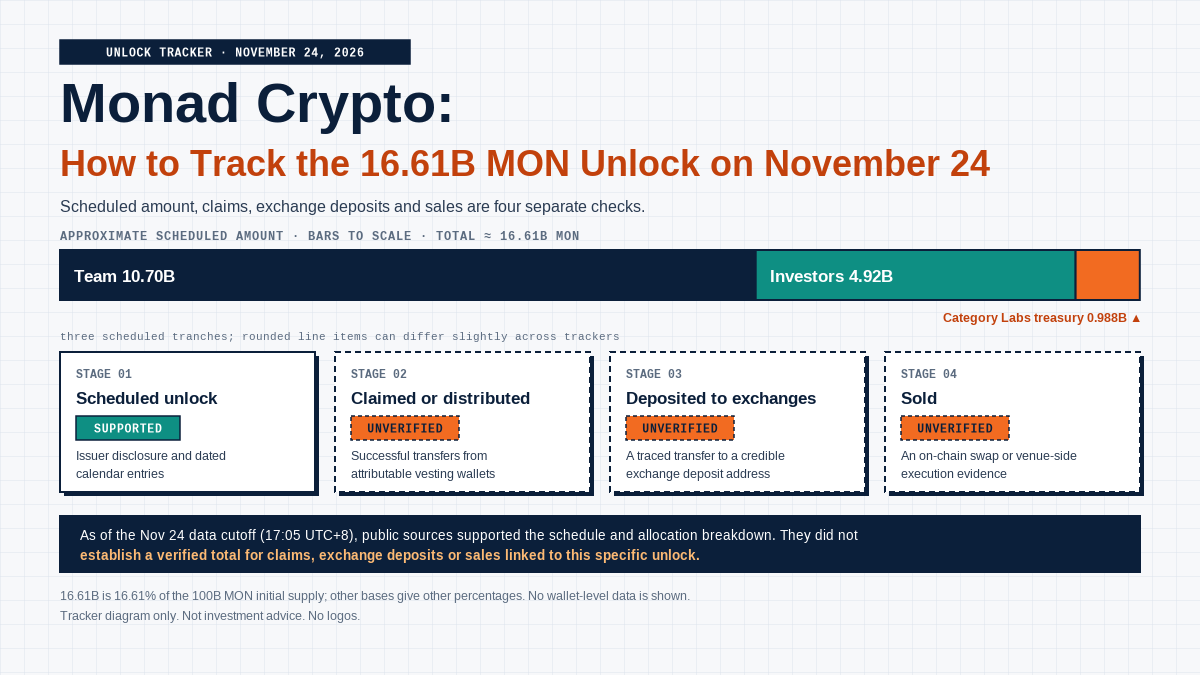
Monad Crypto: How to Track the 16.61B MON Unlock on November 24
Track Monad’s 16.61B MON unlock on November 24. See the team, investor, and treasury allocations, and learn how to verify claims and exchange deposits.

China Launches AI Standardization Pilot in Five Free Trade Zones
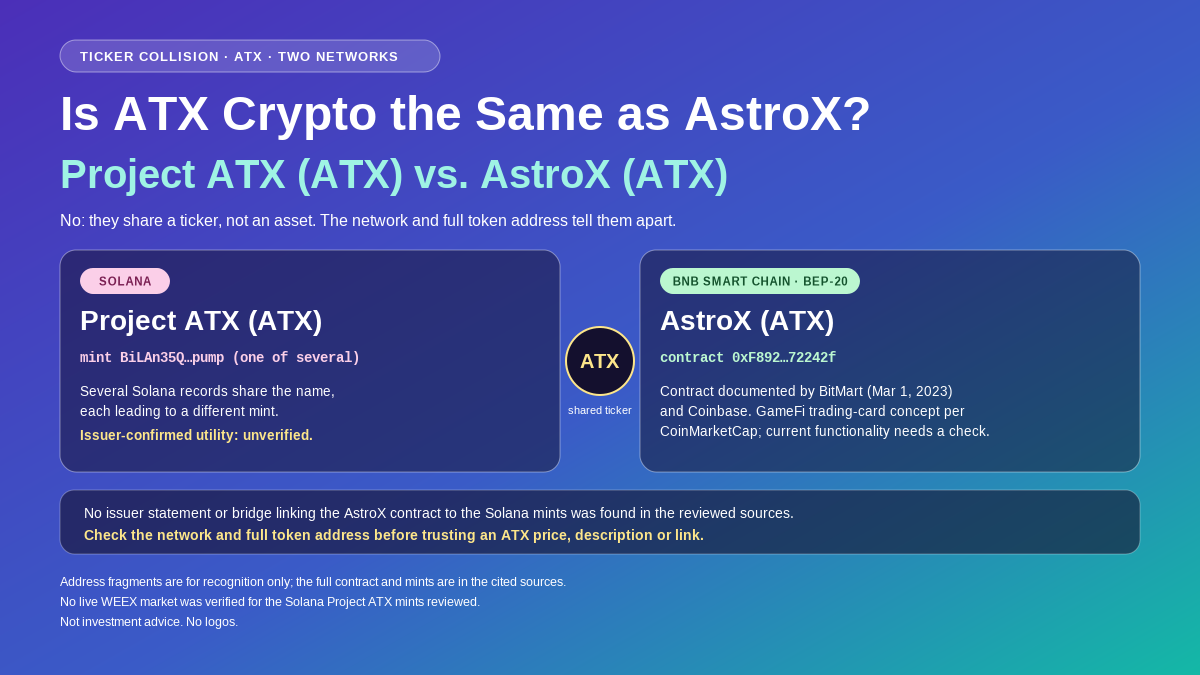
Is ATX Crypto the Same as AstroX? Project ATX (ATX) vs. AstroX (ATX)
Compare Project ATX on Solana with AstroX on BNB Smart Chain. Learn how to verify each token address before trusting an ATX price or buying guide.

Bayer Signals Future Pharmaceutical Deals May Target Mid-Stage Clinical Assets

Ethereum ETF: $96 million in net inflows stop the November bleeding
AI Agents in Payments: Cards Dominate, Yet Stablecoins Fill the 'Gap'|a16z Frontier

Grayscale Claims Bitcoin and Major Assets Are Oversold, Market Outlook Affected by AI Risks

Jensen Huang's "Miraculous Return" Forces Investment Banks to Rewrite Reports Overnight

Applied Digital Stock Surged 20% on a Hyperscaler Deal. What to Know About Its $41 Billion in Leases

Hewlett Packard Enterprise Q4 Earnings Exceed Market Expectations, Board Approves $5 Billion Stock Buyback Plan

Nvidia vs. SpaceX: The AI Revolution Is Big Enough for Both. Here's the Better Buy.

Bitcoin’s supply squeeze narrative faces scrutiny after 11,000 BTC moves to Kraken

Reactions Prove 167-Year-Old Riemann Hypothesis with Help from Claude; Are We Close to Superintelligence?

3 Unstoppable AI Stocks to Buy Hand Over Fist Before the End of 2026

Texas Pacific Land Company Acquires EagleRock Land in $3 Billion All-Stock Deal

Central Bank Anti-Money Laundering Bureau Emphasizes Need for Enhanced Cooperation Against Cross-Border Money Laundering Networks

Sandisk Just Split Its Stock 8-for-1. Is It Time to Buy?

XRP Ledger lending upgrade just 5 votes away from approval

Media: Jensen Huang and His Wife Have Accumulated Vast Wealth

The Scarce Dividend in the Autonomous Taxi Race: Supporting Service Stations
Ethereum: AI Becomes a More Urgent Threat than Quantum
OPEC+ to Finalize 2027 Production Policy Amid Intensified Uncertainty from Iran War and Internal Disputes
Payment Giant Stripe Negotiates Acquisition Offer Valued Over $200 Billion, Launches Stablecoin Spending Card with Deel
Ansem and Satoshi Nakamoto: Living Under the Same 'Stolen' Roof
Quickben22 Rechecks 2018 Bitcoin Dormant Address List: Nearly 10,000 Dormant Addresses Restart Transfers After Eight Years, Transferring a Total of 245,000 BTC
Flop Labs Led by Arthur Hayes Launches FLOP Testnet, Initial Airdrop Scoring Not Yet Started
Latest articles


Latest coin listings on WEEX


