
Rising Treasury Yields and Dollar Amid Oil and Employment Concerns; Gold Declines

 Prefer us on Google


[Mexico City = Shim Young-jae, Correspondent] In the New York financial market, U.S. Treasury yields and the dollar rose together. Tensions surrounding the Strait of Hormuz have pushed international oil prices higher, highlighting inflation concerns and the possibility of further tightening by the Federal Reserve (Fed). Investors adjusted their positions while monitoring the progress of negotiations regarding shipping through the Strait between Iran and Oman, ahead of the U.S. employment report for July to be released the next day.
On the 6th (local time), the dollar index recorded an increase of 0.268 points (0.27%) to 99.619. During the day, it rose to 99.65, surpassing the previous day's closing price of 99.351. The dollar-won exchange rate traded at 1.49 won (0.10%) higher at 1423.36 won. The yield on the U.S. 10-year Treasury bond rose by 6.1 basis points to 4.676%, while the price of gold fell by $10.49 (0.25%) to $4239.44 per ounce.
Surge in Oil Prices Leads to Rising Treasury Yields... 10-Year Yield at 4.676%
U.S. Treasury yields rose across the board. The 10-year yield increased by 6.1 basis points to 4.676%, while bond prices fell by 0.48%. The 2-year yield rose by 6.8 basis points to 4.247%, and the 30-year yield traded at 5.22%, up by 4.7 basis points.
The direct background for the rise in yields was international oil prices. Iran's semi-official Fars news agency reported that an Iranian parliamentary committee is reviewing a draft bill to restrict the passage of vessels from so-called hostile countries, including the U.S. and Israel, through the Strait of Hormuz. As a result, West Texas Intermediate crude for September delivery rose by about 3% to $77.29 per barrel, while Brent crude increased by approximately 4% to $82.49.
The rise in energy prices has raised concerns about renewed inflationary pressures. If oil prices remain high, transportation costs and manufacturing expenses will increase, which could lead the Fed to maintain high interest rates for an extended period or consider further hikes.
However, there were also reports that Iran and Oman are approaching a temporary agreement to reopen the Strait of Hormuz. President Trump stated that an agreement to reopen the Strait is imminent, but the U.S. maintains its position that it will not agree to any measures that allow Iran to control access to the Strait. The intersection of expectations for progress in negotiations and concerns over control of the Strait has increased volatility in the bond market.
Clark Bellin, President and Chief Investment Officer of Bellwether Wells, stated, "The employment report could exert upward or downward pressure on Treasury yields, which are currently at the upper end of the recent trading range. If yields rise excessively, the relative attractiveness of stocks may diminish, limiting gains in the stock market."
Dollar Index at 99.619... Dollar-Won at 1423.36 Won
According to TradingView, the dollar showed strength due to safe-haven demand and rising U.S. interest rates. The dollar index rose by 0.27% to 99.619. During the day, it climbed to 99.98, rebounding from a six-week low recorded earlier in the week.
The dollar also continued to strengthen against the yen. The dollar-yen exchange rate rose by 0.41% to 158.41 yen, marking three consecutive days of gains. Following joint intervention by U.S. and Japanese financial authorities, the yen showed strength, causing the dollar-yen exchange rate to drop to 155.20 yen earlier in the week, but some retracement occurred afterward.
The euro fell by 0.29% against the dollar, trading at $1.1519, while the pound traded down by 0.12% at $1.3454.
John Velis, BNY's foreign exchange and macro strategist, explained, "The yen's strength at the beginning of the week was accompanied by dollar weakness, but the market is currently waiting for the outcome of negotiations in the Persian Gulf and the U.S. employment report. Trading is generally quiet ahead of the non-farm payroll announcement."
The strength of the dollar has also put pressure on the won. The dollar-won exchange rate recorded an increase of 1.49 won to 1423.36 won. During the day, the exchange rate briefly rose to around 1428 won before reducing its gains. The global strength of the dollar and rising U.S. Treasury yields led to the weakness of the won, but in the latter half of the day, profit-taking and expectations for negotiations limited the extent of the increase.
Francesco Pesole, ING's foreign exchange strategist, forecasted, "The importance of all indicators released after the July Federal Open Market Committee meeting has increased. If the employment data comes in strong, dollar buying positions, particularly against the yen, could expand again."
The market expects that U.S. non-farm employment in July will increase by around 80,000, with the unemployment rate remaining at 4.2%. The increase in employment in June was 57,000. If the employment data exceeds market expectations, the possibility of a Fed rate hike will increase, leading to further rises in the dollar and Treasury yields.
Gold Falls by 0.25%... Rate Pressure Outweighs Safe-Haven Demand
Gold prices fell after a sharp rise the previous day. According to TradingView, gold was priced at $4239.44 per ounce, down $10.49 (0.25%). The previous day's closing price was $4249.93. Reuters reported that U.S. gold futures fell by about 0.1% to $4299.60.
Gold had risen to its highest level since June 18 due to geopolitical uncertainty early in the session, but the rise in oil prices triggered inflation concerns, and the simultaneous increase in Treasury yields and the dollar led to a reversal of gains. Gold does not pay interest, so when rates rise, the opportunity cost of holding gold increases.
Jim Wyckoff, a market analyst at American Gold Exchange, stated, "If Iran's legislation regarding the Strait of Hormuz drives oil prices higher again, inflation concerns could intensify. Such an environment could prolong the central bank's high-interest rate stance."
Bob Haberkorn, Senior Market Strategist at StoneX, remarked, "The key variable for the gold market remains the Fed's policy path. The U.S. employment report will have a significant impact on future interest rate outlooks."
According to the CME FedWatch, the market reflects a 57% probability of a rate hike in September, with an 84% chance of a hike by December. Despite a more than 4% surge in gold prices the previous day, the market faced adjustments due to rising rate pressures, even with buying interest following a technical breakout of resistance levels.
The future direction of the bond and foreign exchange gold markets is expected to be influenced by U.S. employment data and the outcome of negotiations regarding the Strait of Hormuz. If employment comes in stronger than expected or oil prices rise further, there could be upward pressure on Treasury yields and the dollar. Conversely, if employment slows and negotiations for reopening the Strait progress, both rates and the dollar may reverse some of their gains. Gold is expected to experience increased volatility between safe-haven demand due to geopolitical instability and the pressures of high rates and a strong dollar.
-- Price
This content is provided for general informational purposes only and doesn't constitute financial, investment, legal, or tax advice. Any events, rewards, online promotions, or related information mentioned herein should not be considered a recommendation, solicitation, or invitation to purchase, sell, trade, or otherwise deal in any crypto assets. Crypto assets are highly volatile and may result in loss. The availability of WEEX services, products, and related events may vary by region. You are responsible for ensuring that your participation is in accordance with applicable local laws and regulations.
You may also like

Shenzhen Stock Exchange Introduces New Fee Reduction Measures, Expected to Benefit the Market by 1.39 Billion Yuan

White House Plans to Reduce Use of Special Government Employee Status, Involving Musk and David Sacks

Port Security Personnel at Los Angeles Reach Temporary Agreement to Avert Strike Threat

Follow the Money: Variational Raises $110 Million, Tether Activity and M&A Deals

US Data Center Construction Costs Surge 13% in 2026

South Korean lawmaker says blockchain could be the answer to ‘AI totalitarianism’

Mathematicians Disheartened by OpenAI Are Now Building Their Own AI Models from Scratch

Where is Nvidia Investing Its Money?
Ethereum Glamsterdam Upgrade May Be Delayed Until May 2027

UK Grid Reform Leads to Extended Project Connection Times

SpaceX's Two Major Business Growth Prospects Favorably Viewed by Wall Street! Starship Launch Economic Benefits Are Impressive, AI Data Center Investment Expected to Break Even in One Year

What Time Is the Anthropic IPO? When ANT Stock Starts Trading on Nasdaq
What time is the Anthropic IPO? Check ANT’s November 19 Nasdaq debut, global opening-bell times, the $83 offer price, and why orders may stay pending.
Solana co-founder pitches onchain basket to track global economy

Japan’s yen stablecoin issuer JPYC extends app outage with no recovery date

China Passenger Car Association: Negative Growth in Domestic Retail in November

Axe Compute Reports Q3 Revenue of $7.24 Million, Up 125% Quarter-over-Quarter, Cash Reaches $148 Million

Technical Failures Disrupt Key Systems in the U.S., from Flight Cancellations to Banking Delays

Further Arrests in the Zondacrypto Scandal. Prosecutor Talks About Three Individuals

Service Disruptions at Major U.S. Banks Affecting Customer Accounts and Payments

Shenzhen PCB Leaders Have Orders for High-End Products Until 2028

Orders for Diesel Generators Extended to October 2027

Trezor found implants in reseller wallets. What protects the buyer?

Why is the only spot Bitcoin ETF in continental Europe acquired by an Asian group, BIT?
Samsung Partners with Google to Challenge Meta's Monopoly in the AI Glasses Market

What Licenses Are Needed for Crypto Payments in Hong Kong?

Nakamoto Q3 Financial Report: Holds 4,283 BTC, Net Profit of $85.5 Million

CFTC, DOJ sue Arkansas to stop Kalshi gambling lawsuit
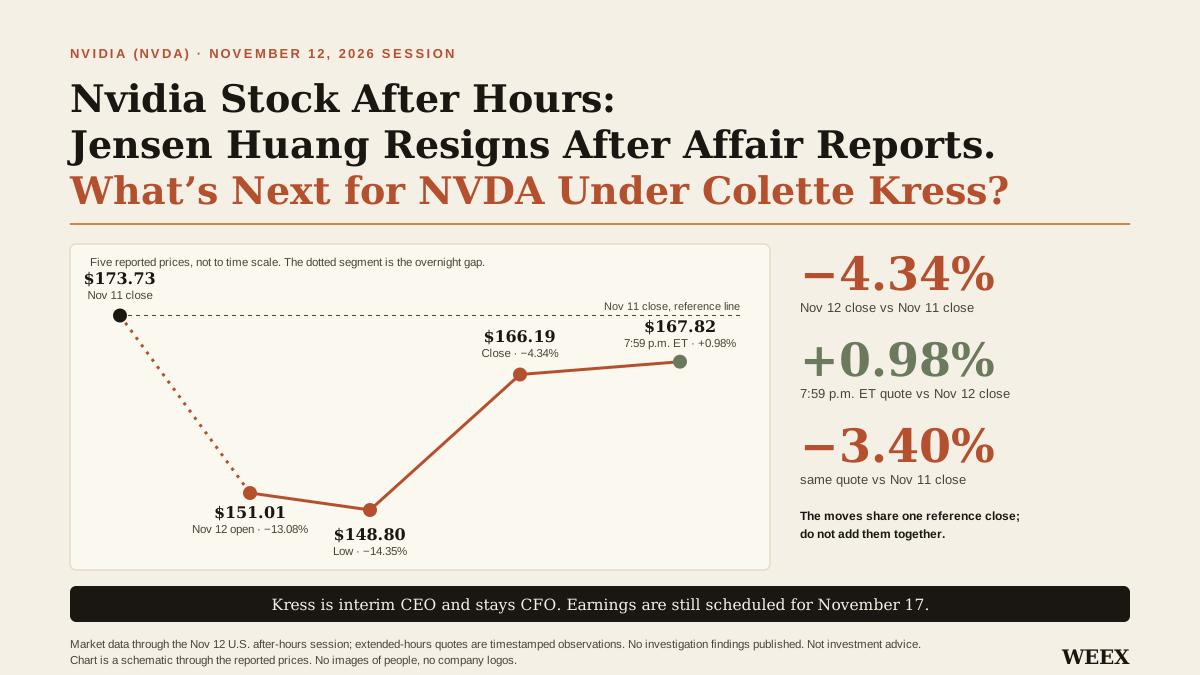
Nvidia Stock After Hours: Jensen Huang Resigns After Affair Reports. What’s Next for NVDA Under Colette Kress?
Nvidia fell 4.34% after Jensen Huang resigned, then rose 0.98% after hours. See what Colette Kress’s appointment means for NVDA and November 17 earnings.

The market demanded liquidity and the Economy granted it: what to expect for interest rates after the Treasury auction

FTX's Fourth Anniversary: When Bankruptcy Becomes a Business
Shenzhen Stock Exchange Introduces New Fee Reduction Measures, Expected to Benefit the Market by 1.39 Billion Yuan
White House Plans to Reduce Use of Special Government Employee Status, Involving Musk and David Sacks
Port Security Personnel at Los Angeles Reach Temporary Agreement to Avert Strike Threat
Follow the Money: Variational Raises $110 Million, Tether Activity and M&A Deals
US Data Center Construction Costs Surge 13% in 2026
South Korean lawmaker says blockchain could be the answer to ‘AI totalitarianism’
Latest articles



Latest coin listings on WEEX


