
Jensen Huang: Future Telecom Base Stations Expected to Evolve into Distributed AI Networks, All Telecom Operators Will Provide AI Computing Power

 Prefer us on Google


On October 21, Jensen Huang, CEO of NVIDIA, stated at the GTC conference held in Berlin that all telecom operators will provide AI computing power in the future, and telecom base stations are expected to evolve into distributed AI networks. He compared the AI economy to a five-layer cake composed of energy, computing power, AI factories, models, and applications, pointing out in his presentation that only NVIDIA's logo appeared on the computing power layer. Other layers included energy companies such as Siemens Energy and Schneider Electric, AI factory builders Nscale and Firebird, and European AI model companies Mistral, legal AI company Legora, and translation tool DeepL. Huang also mentioned that the cost of building a 1-gigawatt data center is currently about $50 billion, covering expenses for land, electricity, construction, computing equipment, storage, and cooling.
At the same time, NVIDIA launched the DSX Pod AI factory to accelerate the deployment of AI infrastructure in Europe; the DSX Pod can shorten deployment time to as fast as 14 days; the European industrial ecosystem collaborates with NVIDIA DSX to create the world's most energy-efficient AI factory.
The DSX AI factory platform uses closed-loop liquid cooling and dry coolers, reducing the facility's cooling water usage to nearly zero, saving up to 54 million liters of water daily at a scale of 2 gigawatts. The DSX MaxLPS software can help operators reduce power consumption by up to 30% while maintaining the same token output.
NVIDIA introduced the OpenShell reference architecture, integrating the Vera Rubin infrastructure, Vera Central Processing Unit (CPU), BlueField-4 Data Processing Unit (DPU), and OpenShell secure runtime software, to help enterprises build, run, and manage AI agents at scale, while monitoring and enforcing security constraints on their behavior. This architecture continuously monitors agent behavior through the NVIDIA Sentry security framework running on BlueField-4 and enforces security policies at the hardware level. When an agent attempts to breach the boundaries set by the software, the system can isolate and stop it within milliseconds. NVIDIA claims that the Vera Rubin NVL72 system can achieve a throughput of up to 30 times the previous level per megawatt under agent workloads, and NVIDIA Sentry can increase agent capacity by up to 20%. This architecture supports enterprise environments such as Linux, Kubernetes, and Microsoft Windows, and can be scaled to edge devices. Companies such as Microsoft, Google Cloud, Dell Technologies, Cisco, OpenAI, and Anthropic are participating in related collaborations.
Updating...
-- Price
This content is provided for general informational purposes only and doesn't constitute financial, investment, legal, or tax advice. Any events, rewards, online promotions, or related information mentioned herein should not be considered a recommendation, solicitation, or invitation to purchase, sell, trade, or otherwise deal in any crypto assets. Crypto assets are highly volatile and may result in loss. The availability of WEEX services, products, and related events may vary by region. You are responsible for ensuring that your participation is in accordance with applicable local laws and regulations.
You may also like

Evan Conrad: Most AI Startups Will Be Unable to Purchase Computing Power in the Next 6 Months

MiniMax M3.1 Flash Open Source Processes Over 100 Trillion Tokens in 72 Hours

Nasdaq Falls 2.6%, Largest Single-Day Drop Since June

Meta Accumulates $825 Billion in AI Commitments by 2036

Perceptron Migrates 800,000 Nodes to Walrus for AI Data Verification

Google Pre-Market Drops About 2% Due to Computing Power Strain and OpenAI's Advertising Expansion

CICC: How to Hedge AI Risks?
Goldman Sachs: Silver Market Faces $2.2 Billion Sell-off and Dual Pressure

JPMorgan: Tech Sector Expected to Have $400 Billion Surplus This Year, AI Investment Cycle Stable

LiteLLM Suffers Supply Chain Attack, Malicious Version 1.107.0 Steals Sensitive Data
Swell DAO Admin Keys Suspected of Being Compromised, Malicious Contracts Threaten to Steal 2,500 ETH
Railway Security Incident: Potential Leak of User Environment Variables and API Keys, All Deployments Suspended
Anthropic Launches Research Preview of Claude Duet

NEAR AI tops 1 million tokens staked as rewards fund AI inference

Anthropic PBC Plans Spending Up to $750 Billion Before IPO

CoreWeave Launches Physical AI Launchables to Simplify Physical AI Workloads

FSB Proposes 12 Practices for AI Governance in Financial Institutions

Aethir Updates ATH Token Economic Mechanism, Daily Burn Mechanism Launches in November

Morgan Stanley: What Can the U.S. Midterm Elections Change? AI and Fiscal Policy Take Center Stage

Is 2008 Repeating? CDS Returns to Market Focus
Anthropic Reports $16.3 Billion Revenue in First Half, Future Computing Commitments May Reach $75 Billion

Grayscale Research Director Says Decline in Computing Stocks, Demand Will Remain

Google Cloud Outage: Revolut Paralyzed, Crypto Balances Show Zero

MoneyGram Joins XDC Network as Institutional Validator
Morgan Stanley Warns of Multiple Risks in U.S. AI Infrastructure Investment, Predicts 32 GW Power Shortage by 2028

Xie Jiayin: TiDB Cloud Hacked, Bitget Suspended for Two Months Without Data Leakage

Capital as Production Capacity: Where Did the Money of the Top 100 VC and CVC in the U.S. Go in the First Three Quarters of 2026?
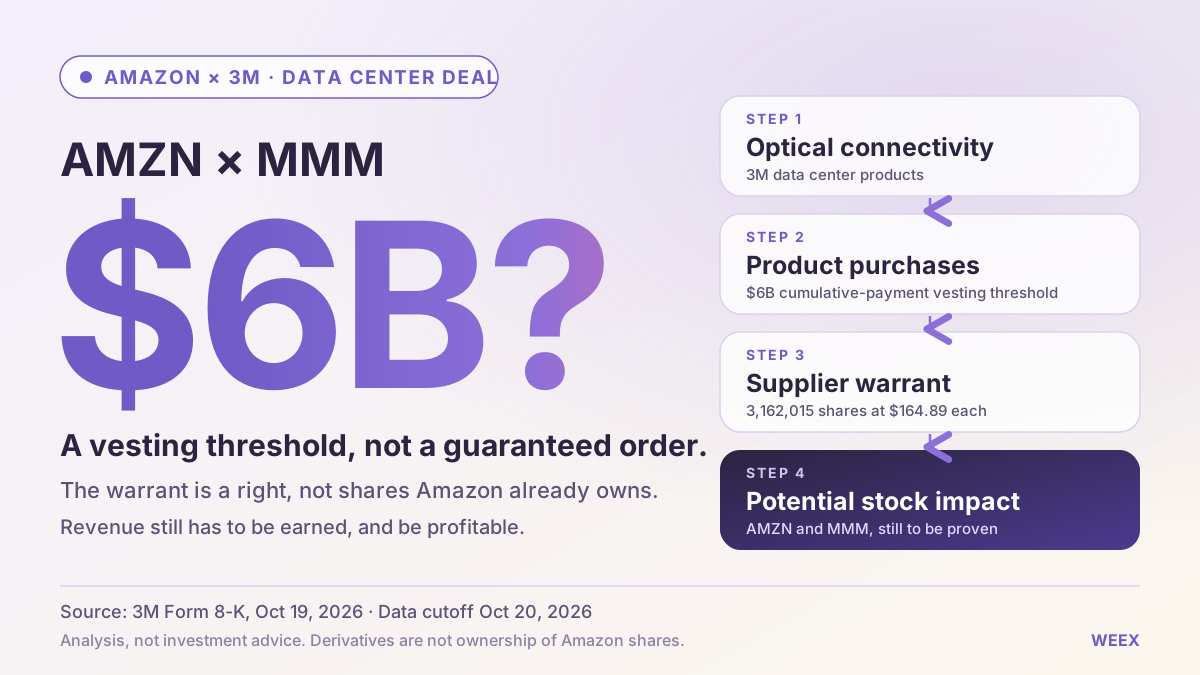
Amazon’s 3M Data Center Deal: What It Means for Amazon (AMZN) and 3M (MMM) Stock
Assess Amazon’s 3M data center deal, the $6 billion warrant threshold, potential dilution, and what the agreement could mean for AMZN and MMM stock.

Why Are Companies Reducing AI Spending? What It Means for AI Stocks

Elice Group IPO Plummets 28% on First Day
Evan Conrad: Most AI Startups Will Be Unable to Purchase Computing Power in the Next 6 Months
MiniMax M3.1 Flash Open Source Processes Over 100 Trillion Tokens in 72 Hours
Nasdaq Falls 2.6%, Largest Single-Day Drop Since June
Meta Accumulates $825 Billion in AI Commitments by 2036
Perceptron Migrates 800,000 Nodes to Walrus for AI Data Verification
Google Pre-Market Drops About 2% Due to Computing Power Strain and OpenAI's Advertising Expansion




