
Crypto PNL vs Trading Volume: How WEEX WWFC 2026 Leaderboards Work

 Prefer us on Google


Quick Answer
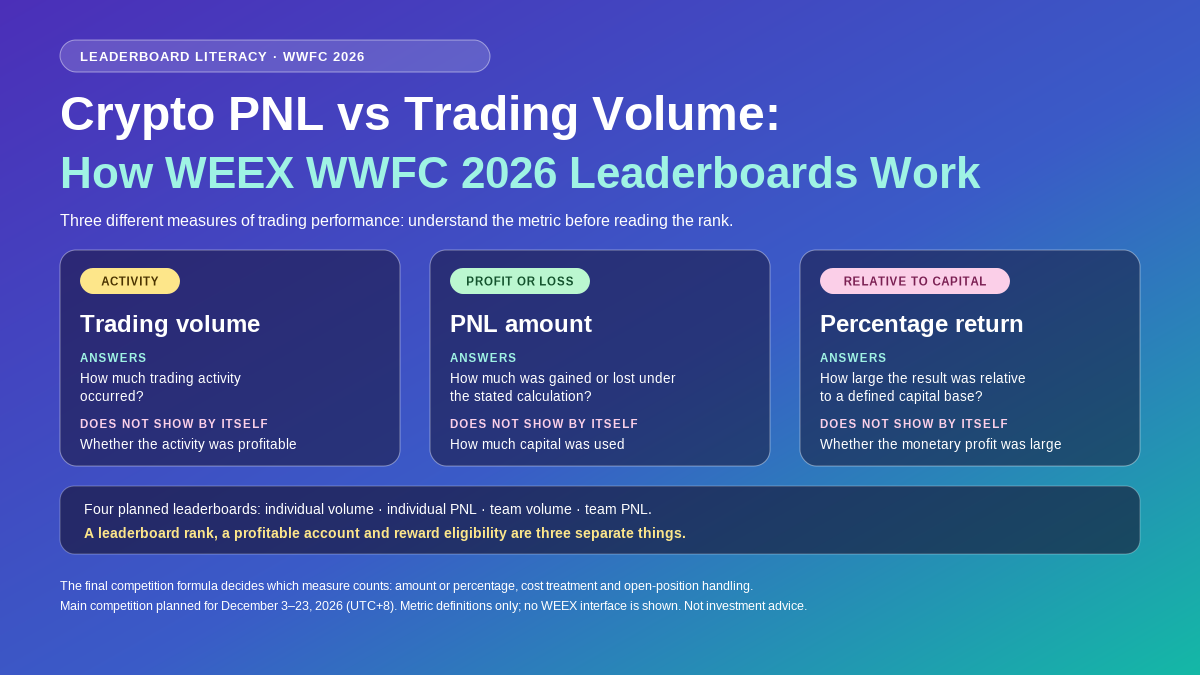
- Trading volume measures how much qualifying trading activity takes place. PNL measures trading profit or loss. High volume does not necessarily mean high profit.
- WEEX WWFC 2026 plans four leaderboards: individual trading volume, individual PNL, team trading volume, and team PNL.
- PNL expressed as a monetary amount is different from a percentage return. The final competition formula determines which measure counts.
- A visible leaderboard position, a profitable account, and reward eligibility are three separate things.
At WEEX, we believe a useful trading competition should make these distinctions clear. A trader who generates the most activity has not necessarily produced the strongest financial result. Equally, a high percentage return does not necessarily represent the largest profit. Understanding the metric comes before interpreting the rank.
What Does a Crypto Trading Leaderboard Actually Measure?
A leaderboard is an ordered list based on a defined score. Its meaning depends on the calculation behind that score—not simply the position displayed next to a trader’s name.
A volume ranking answers a question about qualifying trading activity. A PNL ranking answers a question about performance under a particular profit-and-loss formula. A team ranking adds another layer: which members contribute to the score and how their results are combined.
Our planned WEEX WWFC 2026 competition separates these dimensions into four leaderboards. Individual and team participation are distinct, and each has a trading-volume and PNL ranking.
That structure gives participants different ways to be evaluated. It does not mean that the same trader or team will lead every board.
Trading Volume vs PNL: The Core Difference
Trading volume measures transactions. PNL measures a gain or loss.
For a simple linear futures example, transaction notional can be calculated from the executed quantity multiplied by the execution price. Competition rules then determine which transactions contribute to eligible volume.
PNL starts with the financial result of the position. Its treatment can differ depending on whether the position is still open, whether costs are included, and how the event defines its scoring window.
| Metric | Main Question It Answers | What It Does Not Show by Itself |
|---|---|---|
| Trading volume | How much trading activity occurred? | Whether the activity was profitable |
| PNL amount | How much was gained or lost under the stated calculation? | How much capital was used to achieve that result |
| Percentage return | How large was the result relative to a defined capital base? | Whether the monetary profit was large |
| Leaderboard rank | Where does the score stand against other eligible entries? | Whether a reward has been finalized |
The distinction matters because the same account can look strong under one metric and weak under another. A high-volume trader can lose money, while a profitable trader can have comparatively little turnover.
-- Price
A Worked Example: More Volume, Less Profit
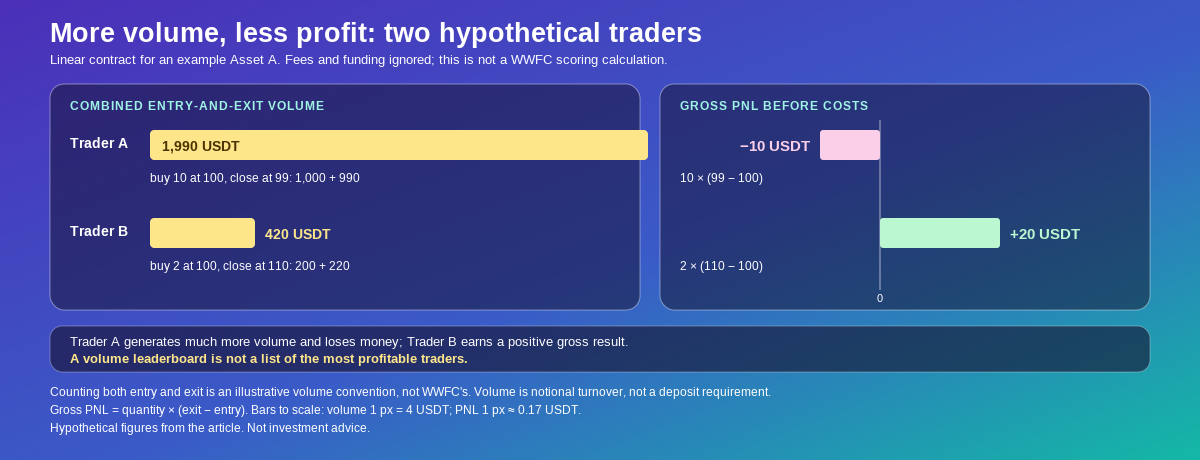
Consider two hypothetical traders using a linear contract for Asset A. The example ignores fees and funding to isolate the difference between turnover and gross PNL. It is not a WWFC scoring calculation.
Trader A buys 10 units at 100 USDT and closes the position at 99 USDT.
- Opening notional: 10 × 100 = 1,000 USDT.
- Closing notional: 10 × 99 = 990 USDT.
- Gross PNL: 10 × (99 − 100) = −10 USDT.
If an illustrative volume convention counts both entry and exit, the combined volume is 1,990 USDT.
Trader B buys two units at 100 USDT and closes at 110 USDT. The opening notional is 200 USDT, the closing notional is 220 USDT, and gross PNL is +20 USDT. Under the same illustrative convention, combined volume is 420 USDT.
| Illustrative Result | Trader A | Trader B |
|---|---|---|
| Opening notional | 1,000 USDT | 200 USDT |
| Closing notional | 990 USDT | 220 USDT |
| Combined entry-and-exit volume | 1,990 USDT | 420 USDT |
| Gross PNL before costs | −10 USDT | +20 USDT |
Trader A generates much more volume. Trader B earns a positive gross result while Trader A loses money.
This is why a volume leaderboard should not be presented as a list of the most profitable traders. It measures a different achievement. The example also shows why competition volume must not be confused with a deposit requirement: notional turnover is not the same as the money transferred into an account.
Is PNL the Same as ROI?
No. PNL commonly refers to a profit or loss amount, while ROI or return rate expresses performance relative to a defined capital base.
Suppose Trader C earns 100 USDT using a 1,000 USDT reference balance. A simple return calculation would be 10%.
Trader D earns 200 USDT using a 10,000 USDT reference balance. Under the same simple approach, the return would be 2%.
Trader D has the larger monetary profit. Trader C has the higher percentage return.
| Hypothetical Trader | Reference Capital | Profit | Simple Return |
|---|---|---|---|
| Trader C | 1,000 USDT | 100 USDT | 10% |
| Trader D | 10,000 USDT | 200 USDT | 2% |
A profit-amount ranking would place D ahead of C. A percentage-return ranking would reverse the order.
The reference capital also matters. A platform’s position return may use a different denominator from an event’s account-level return. Deposits, withdrawals, transfers, and changes in margin can affect how an adjusted formula works.
For WWFC 2026, do not assume that a “PNL” label means percentage return—or that a return percentage displayed elsewhere in an account is the competition score. Read the final leaderboard definition.
Why Can Realized and Unrealized PNL Differ?
Unrealized PNL describes the changing result of an open position. Realized PNL concerns the result associated with closing a position. WEEX’s PNL guidance distinguishes these two categories and explains that open-position estimates fluctuate with the mark price.
That difference becomes important at a competition cutoff.
Imagine a participant has a closed-position gain and an open position showing a loss. A leaderboard that counts only a defined realized result could differ from one that includes an end-of-period valuation of open positions.
Neither approach should be assumed without reading the event rules. The scoring method determines how the result is treated.
Costs require the same care. A gross price-difference calculation is not automatically a net account result. Trading fees and funding payments may change the economics of a position, while the competition formula determines how those items affect the displayed score.
The practical lesson is to compare like with like. An open-position estimate, a completed-trade result, and an event-adjusted PNL figure may answer different questions.
Does Higher Leverage Automatically Increase Competition Performance?
Higher leverage does not automatically create a better trade or a stronger PNL result.
For a fixed position quantity, the same price move produces the same gross price-difference PNL regardless of how much initial margin supports that position. Increasing leverage can reduce the initial margin required, which can change a margin-based return percentage. It also changes the position’s risk characteristics.
If a trader uses leverage to open a larger position, both potential gains and losses become larger because the exposure has increased. More exposure is not the same as better performance.
This distinction is especially relevant when comparing screenshots. A large percentage displayed on a small-margin position may not represent a large monetary profit, and it may not correspond to the competition’s calculation.
Participants should understand position size, margin, and liquidation exposure independently of any ranking objective.
How Do WWFC 2026’s Four Leaderboards Fit Together?
The planned four-board structure separates two questions: whose result is being measured, and what measure is being used.
| Planned Leaderboard | Subject | Metric Category | Final Rule to Check |
|---|---|---|---|
| Individual trading volume | One participant | Eligible transaction volume | Included transactions, timing, exclusions, and minimum requirements |
| Individual PNL | One participant | Event-defined profit and loss | Amount or percentage, cost treatment, and open-position handling |
| Team trading volume | A team | Eligible member trading activity | Which members and transactions contribute |
| Team PNL | A team | Event-defined team performance | Aggregation, member selection, losses, and qualification |
The labels establish the structure, but they do not provide every calculation detail.
For example, a team PNL board might aggregate eligible members’ results, select a subset, or apply another defined methodology. Only the published 2026 rules can establish which approach is used.
Likewise, the existence of individual and team boards does not, by itself, confirm that every participant can receive rewards from all four. Any simultaneous-award conditions must be checked separately.
Why Team PNL Cannot Be Assumed to Be an Average
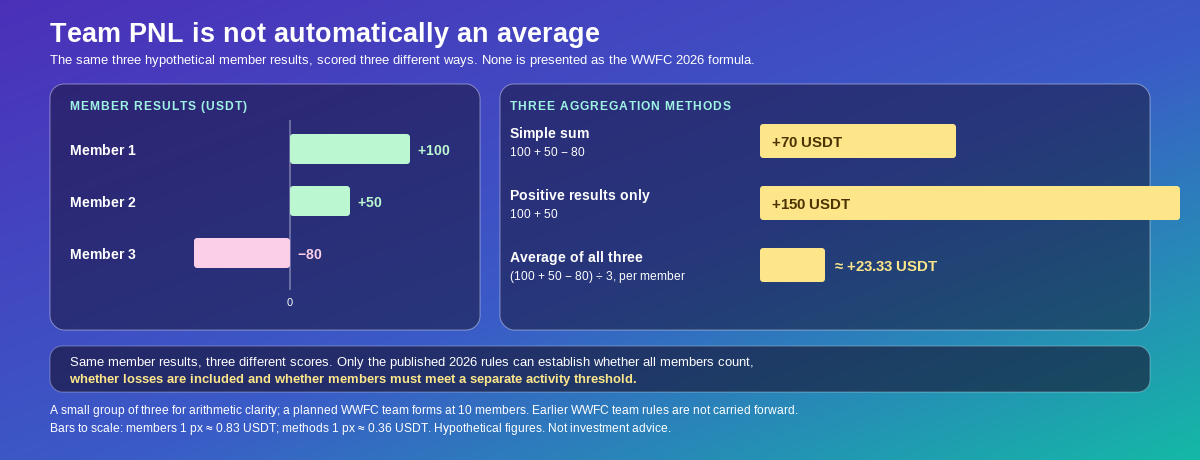
A team score requires an aggregation rule. Different rules can produce different rankings from exactly the same member results.
Consider a hypothetical group with three eligible results: +100 USDT, +50 USDT, and −80 USDT.
A simple sum produces +70 USDT. A formula that sums only positive results produces +150 USDT. An average of all three produces approximately +23.33 USDT per member.
These are not competing descriptions of one calculation. They are three different calculations.
The example is deliberately a small group for arithmetic clarity; it is not a model of a WWFC 2026 team or its scoring. The planned WWFC team-formation requirement is 10 members.
The key point is that a team’s visible membership count does not tell you how its score is calculated. Check whether all members count, whether losses are included, and whether each member must satisfy a separate activity threshold.
Historical WWFC rules should not be carried forward automatically. Earlier editions used season-specific team calculations and qualification conditions.
Which Transactions Count Toward Competition Volume?
A transaction in an account’s history is not automatically an eligible competition transaction.
The final event rules need to establish the relevant time window, supported products, account types, and exclusions. They may also specify how special trading conditions affect the credited result.
Before interpreting your WWFC score, check these questions:
- Does counting begin at registration, the main competition start, team joining, or another defined time?
- Are both opening and closing transactions included?
- How are positions opened before the scoring window treated?
- Which contracts, account types, or transaction categories are excluded?
- What additional conditions apply to receiving a reward?
These are calculation requirements, not minor details. Two participants with similar account turnover can have different eligible event volume if their transactions fall under different conditions.
Avoid solving an unclear score by placing more trades. First establish whether the existing activity qualifies.
Why Might Your Account Result Differ From the Leaderboard?
Start by checking whether you are comparing the same metric over the same period.
Your account may show a position-level figure, a daily total, or an account balance change. The competition may use an event-specific result with its own start time and adjustments.
Deposits are not trading profits, and withdrawals are not trading losses. A change in account balance therefore should not automatically be treated as PNL.
Timing is another possible difference. A leaderboard snapshot and an account screen captured later are not simultaneous observations. Check any published refresh schedule before treating a difference as an error.
A useful reconciliation starts with four items: the exact metric label, the start and end times, the eligible transactions, and the status of any open positions. If the discrepancy remains unexplained, preserve the relevant records and ask official support for clarification.
Does a High Rank Guarantee a Reward?
A rank and a reward are different stages of the competition.
A participant may appear on a leaderboard but still need to meet an activity threshold or other condition. A provisional rank can also change before the final scoring cutoff.
For teams, the process has another layer: the team must receive an applicable award, and individual members must satisfy the rules governing distribution.
The planned WWFC 2026 split of 20% for the captain category, 20% for core members, and 60% for qualifying members concerns distribution of a team award. It does not define the team’s PNL score and does not mean every member receives an equal amount.
Keep these questions separate:
What is my score? Where does it rank? Am I eligible for an award? How is that award distributed?
Answering one does not automatically answer the others.
How Should You Prepare for the WWFC Main Competition?
The main competition is planned for December 3–23, 2026 (UTC+8). Before trading begins, read the final rules and identify the leaderboard most relevant to your intended participation.
Record the scoring window, metric definition, eligibility requirements, and treatment of open positions. If participating with a team, also confirm the aggregation method and member qualification rules.
For checking your own records, WEEX’s futures interface and history tools distinguish position information from completed trading records. The App Futures 2.0 update describes position-history details including realized PNL, return rate, trading fees, and funding fees. Those records can help you investigate a result, but they should not be assumed to reproduce an event-adjusted score automatically.
A competition is easier to follow when you understand the measure before the first leaderboard update—not after a result surprises you.
WEEX Editorial View: Read the Metric Before Reading the Rank
Our four-leaderboard structure is meaningful because trading activity and trading performance are not interchangeable.
A volume ranking should be read as a volume ranking. A PNL ranking should be read using its exact formula. Neither metric, by itself, describes a trader’s consistency, drawdown, or overall skill.
We recommend understanding how your result is calculated before drawing conclusions from your position on the board. That makes WWFC more transparent—and helps keep a competition score separate from the financial outcome of your own trading.
FAQ
1. What Is the Difference Between Trading Volume and PNL?
Trading volume measures transaction activity. PNL measures profit or loss under a stated calculation. High volume can coexist with a loss.
2. Is PNL the Same as Percentage Return?
No. A monetary PNL amount and a percentage return use different measures. Percentage return also requires a defined capital base.
3. Does WWFC 2026 Count Realized or Unrealized PNL?
The final event rules must confirm the scoring method. Do not assume that an open-position estimate or ordinary account PNL is identical to the competition score.
4. Is Team PNL the Sum of Every Member’s Result?
Not necessarily. Team scoring depends on the published aggregation method, member eligibility, and treatment of losses. The 2026 formula should be checked independently of earlier seasons.
5. Can I Receive Rewards From More Than One Leaderboard?
The existence of four leaderboards does not establish simultaneous reward eligibility. Check the final competition rules for applicable combinations, thresholds, and award conditions.
Sources
- WEEX: What Is Profit and Loss and How Is It Calculated? — general PNL definitions and calculation guidance.
- WEEX App Futures 2.0 — trading-record and position-history fields.
- Historical WWFC Competition Rules — background only; historical conditions do not establish the 2026 rules.
This content is provided for general informational purposes only and doesn't constitute financial, investment, legal, or tax advice. Any events, rewards, online promotions, or related information mentioned herein should not be considered a recommendation, solicitation, or invitation to purchase, sell, trade, or otherwise deal in any crypto assets. Crypto assets are highly volatile and may result in loss. The availability of WEEX services, products, and related events may vary by region. You are responsible for ensuring that your participation is in accordance with applicable local laws and regulations.
You may also like

India's Central Bank Proposes 'Trusted Person' Confirmation for Electronic Transfers

PAXG puts gold in a wallet. Getting the bullion out is another matter

XRP Ledger lending upgrade just 5 votes away from approval
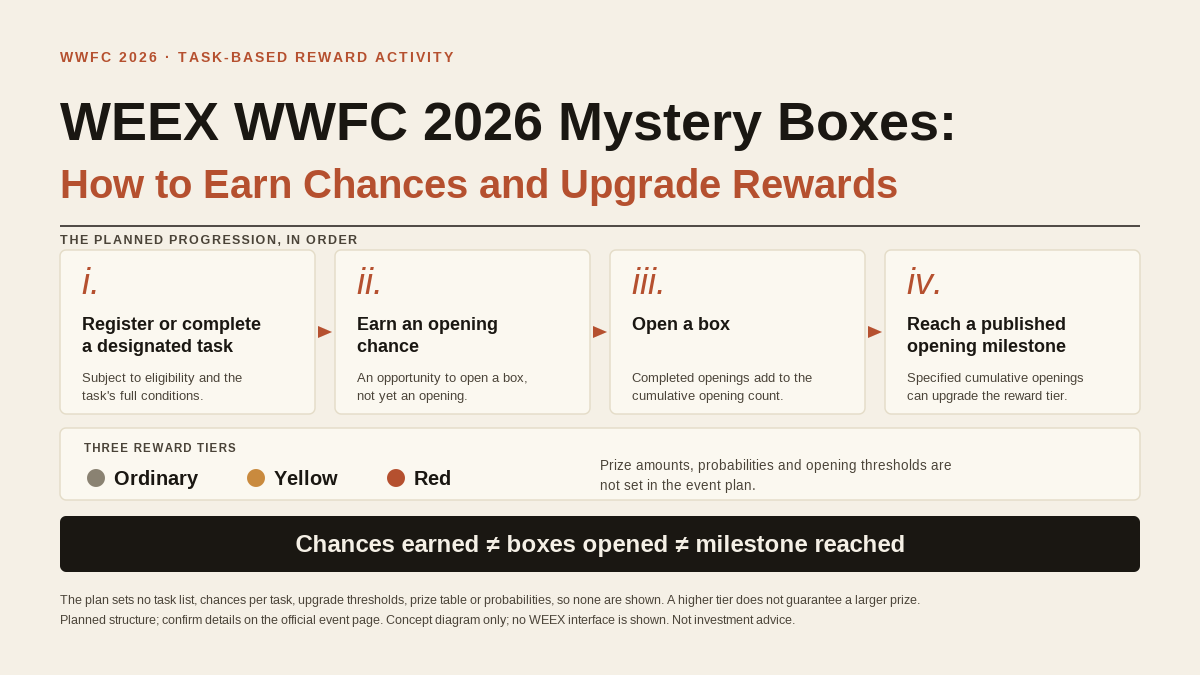
WEEX WWFC 2026 Mystery Boxes: How to Earn Chances and Upgrade Rewards
Explore WEEX WWFC 2026 mystery boxes: how to earn opening chances, understand three reward tiers, and track cumulative openings toward reward upgrades.

Cardano’s $5M event budget faces 5 times more opposition

Repaying a Bitcoin-backed loan on Sui can leave you waiting to withdraw native BTC

Why Bitcoin’s quantum security upgrade may take years

Cysic CEO: Over 6 Million BTC Public Keys Exposed, Accounting for 31.2% of Circulation

Penetrating Social Trading Ledgers: Who is Really Making Profits Amidst the Traffic Noise?

Nearly two-thirds of Square Bitcoin payments were under $20

India Plans to Ease Disclosure Requirements for Foreign Investment Funds
Overview of 6 New AI Mining Projects: Perhaps the Most Noteworthy Track After Privacy Narratives
Bitcoin buyers face a trading issue as stablecoins just suffer their biggest supply drop since 2022
Will the Market Rebound After Thanksgiving? Bank of America: Likely Short-Term, Major Trends Require Three Conditions

XRPL Credit Updates Approaching 29 Vote Threshold
NEAR is cutting inflation. Who pays the cost of fewer new tokens?

What Does the New Bitcoin Price Event Contract Filing Actually Specify?

Report Warns West Antarctic Ice Sheet May Have Crossed Climate Tipping Point

Is Wall Street Trapped? The $80,000 Cost Line of Bitcoin ETF

Meta Plans to Launch AI Device Muse Charm at $300, Smartwatch Delayed to 2027

Oddo BHF Maintains Neutral Outlook on French Government Bonds, AI Sector Repricing in Early Stages

XRPL open-sources a lending app. How would borrowing work?
Institutional Withdrawal and Retail Frenzy: Why is the Eastern European Crypto Market Exhibiting 'Abnormal' Trends?

Optimism Launches Election for Security Council Leader with a 24-Month Term

Hong Kong SFC flags Hyperliquid as suspicious trading platform, can HYPE price hold $65?
Who benefits from Sui’s staking rewards before all its tokens circulate?

1inch moves nearly 9,000 Ethereum after year-long dormancy amid treasury sales

Why Does BlackRock Care About MEV Acquittals? A Trial of 'The Attacker Being Attacked'

US Tightens Remote Computing Power, Goldman Sachs: Southeast Asia Data Center Expansion Will Slow

Crypto: The CCSF, hosted by the Bank of France, aims to regulate advertising and frame staking
India's Central Bank Proposes 'Trusted Person' Confirmation for Electronic Transfers
PAXG puts gold in a wallet. Getting the bullion out is another matter
XRP Ledger lending upgrade just 5 votes away from approval
WEEX WWFC 2026 Mystery Boxes: How to Earn Chances and Upgrade Rewards
Explore WEEX WWFC 2026 mystery boxes: how to earn opening chances, understand three reward tiers, and track cumulative openings toward reward upgrades.
Cardano’s $5M event budget faces 5 times more opposition
Repaying a Bitcoin-backed loan on Sui can leave you waiting to withdraw native BTC
Latest articles





Latest coin listings on WEEX


