
Bitget Launches Open Custody Network to Separate Institutional Trading From Asset Storage

 Prefer us on Google


TL;DR: Bitget announced an Open Custody Network on November 5 intended to connect external banks and institutional custodians with its trading infrastructure. The arrangement aims to reduce the need to keep trading assets directly at an exchange, though the security benefits depend on the exact custody and settlement design.
The largest crypto exchanges have historically offered trading and asset custody within the same service. That is convenient for customers, but it creates a concentration of risk: a platform failure can disrupt access to both execution and the underlying assets. Bitget says it wants to offer another model.
In its November 5 release, the company introduced the Open Custody Network, or OCN, as a connection between external banks, institutional-grade custodians and Bitget's trading infrastructure for eligible users. The stated goal is to make it possible to trade through the venue while relying on a separate custody provider.
Why separation matters after major exchange incidents
When trading and safekeeping sit in the same institution, a customer is exposed to that institution's technology, operational controls, governance and financial health. Independent custody can reduce some of those exposures, especially if a trading venue does not have unilateral control of deposited assets.
But the words 'off-exchange custody' are not a complete security guarantee. A structure can still contain settlement obligations, pre-authorised transfers, credit arrangements or shared service providers. Institutions need to examine who holds legal title, who can initiate a withdrawal and what happens if the trading venue suspends operations.
Those questions have become urgent after recent security incidents. NewsBTC's reporting on Aave restricting new tBTC activity showed that risk often depends on how separate components connect, not only on whether an individual component is technically sound.
The operational challenge: trading without moving the coins
Fast trading platforms need to know that obligations can be settled. Traditional markets solve this with clearing, collateral and regulated intermediaries. Crypto venues have often simplified the problem by holding assets directly in exchange accounts. If assets remain with external custodians, the system needs a dependable way to represent collateral and complete settlement.
That creates design choices around collateral efficiency, counterparty exposure and settlement finality. A custody network can be commercially attractive if it combines external safekeeping with a straightforward trading workflow, but it can also become harder to explain to customers if the protections differ by asset or jurisdiction.
Bitget's release is a company announcement of the network's launch and intended model. It does not independently establish that every partner bank or custodian provides the same services, that all users are eligible, or that risk has been eliminated. Marketing claims should be assessed against contractual details and actual operating history.
What institutions will want to verify
Prospective clients should ask for the participating custodians, the jurisdictions where the service operates, the method used to secure trading obligations, how positions are reconciled and how assets can be retrieved if the venue or a partner fails. Independent security assessments and clear segregation terms are particularly important.
The industry's direction is becoming clearer. As more institutions trade digital assets, they expect the separation of functions familiar from other financial markets. Whether OCN delivers that standard will be judged by its real-world safeguards rather than its branding. For customers, the key question is not simply where assets are stored, but who can move them and under what conditions.
This article was written by the News Desk and edited by Samuel Rae.
-- Price
This content is provided for general informational purposes only and doesn't constitute financial, investment, legal, or tax advice. Any events, rewards, online promotions, or related information mentioned herein should not be considered a recommendation, solicitation, or invitation to purchase, sell, trade, or otherwise deal in any crypto assets. Crypto assets are highly volatile and may result in loss. The availability of WEEX services, products, and related events may vary by region. You are responsible for ensuring that your participation is in accordance with applicable local laws and regulations.
You may also like

Circle Says It Froze $1.1B in USDC Linked to Binance Hack Investigation

Kraken Parent Payward Takes AAVE Stake as Institutions Look Deeper Into DeFi

Chainalysis Begins Restoring Screening Services After Disclosing Exposed Password Hashes

Aave Labs Acquires Avon to Launch Fixed-Rate Lending on Its Protocol

Kraken Owner Invests in Altcoin, Considers Further Purchases. You Should Recognize Him

Aave Labs Acquires Avon Team to Advance Fixed-Rate Lending
GMX DAO Votes to Transfer $7 Million in Assets to POL Multisig as Emergency Reserve
Payward and Clients Purchase AAVE to Explore Collaboration
Ethereum Economic Zone enters code implementation stage for liquidity bridging

Dialectic Launches SpaceX Tokenized Stock Yield Vault Starloop

Aave Labs, Veda, and Kamino Submit Legal Framework for Decentralized Lending to SEC

Aave borrowers faced up to 36% APR while a freeze blocked fresh collateral

The Need for a Benchmark Interest Rate in DeFi: Will Treehouse DOR Become the New Standard for On-Chain Finance?

Onlend Unveils No-Code Infrastructure to Launch Custom Onchain Lending Apps

Chainlink Launches 24/7 RWA and Stock Price Data Service, Aave as Initial Adopter

Ethena Pay Adds Earn+ Through Aave V4 Lending on Avalanche

Aave Expands Stock-Backed USDC Loans on Base for Eligible Investors

Chainlink Unveils 24/7 Pricing for Tokenized Assets as Aave Adopts Feeds
The Same Bad Debt: Five Points of Loss Recognition in DeFi Treasuries

Aave reopens frozen markets but blocks new collateral loans

LlamaRisk Proposes to Lower Borrowing Limits for Aave V3 and V4, Removing Approximately $3.8 Billion in Unused Quotas

Elon Musk Says AI Agents Could Engage in Crypto Theft

Mystery whale withdraws 290 million USDC from Aave, raises borrowing rates

Chainlink Launches 24/7 Price Service for Stocks

Chainlink Launches 24/7 Market Data Service to Support Tokenized Asset Trading
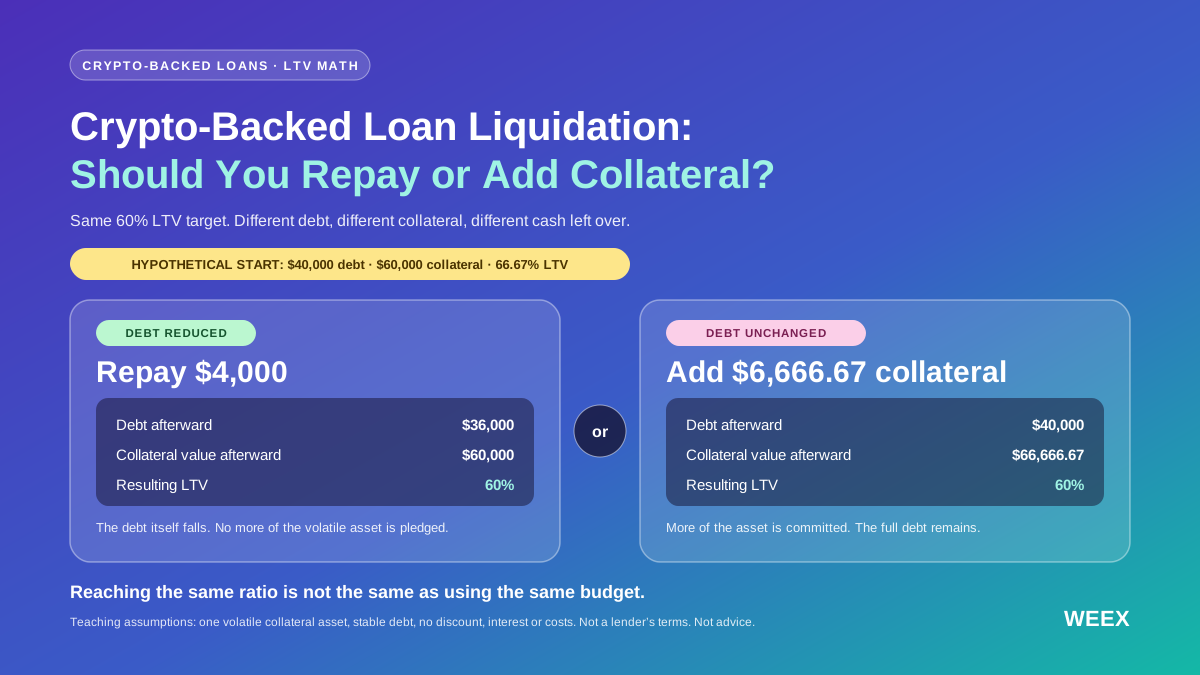
Crypto-Backed Loan Liquidation: Should You Repay or Add Collateral?
Facing crypto-backed loan liquidation? Compare repayment and collateral top-ups using equal budgets, LTV calculations, stress tests and protection limits.

3 payment rules control Aave’s native Bitcoin market, but only WBTC settles them
IOSG Ventures Invests in Funding Infrastructure Fun

Stablecoin Deposits in DeFi Grow to $24 Billion
Aave V3.8 Proposal Preserves Flash-Loan Liquidations
Circle Says It Froze $1.1B in USDC Linked to Binance Hack Investigation
Kraken Parent Payward Takes AAVE Stake as Institutions Look Deeper Into DeFi
Chainalysis Begins Restoring Screening Services After Disclosing Exposed Password Hashes
Aave Labs Acquires Avon to Launch Fixed-Rate Lending on Its Protocol
Kraken Owner Invests in Altcoin, Considers Further Purchases. You Should Recognize Him
Aave Labs Acquires Avon Team to Advance Fixed-Rate Lending
Latest articles


Latest coin listings on WEEX


