
Ethereum Glamsterdam Delayed: Could 15,000 Smart Contracts Be at Risk?

 Prefer us on Google

Key Takeaways
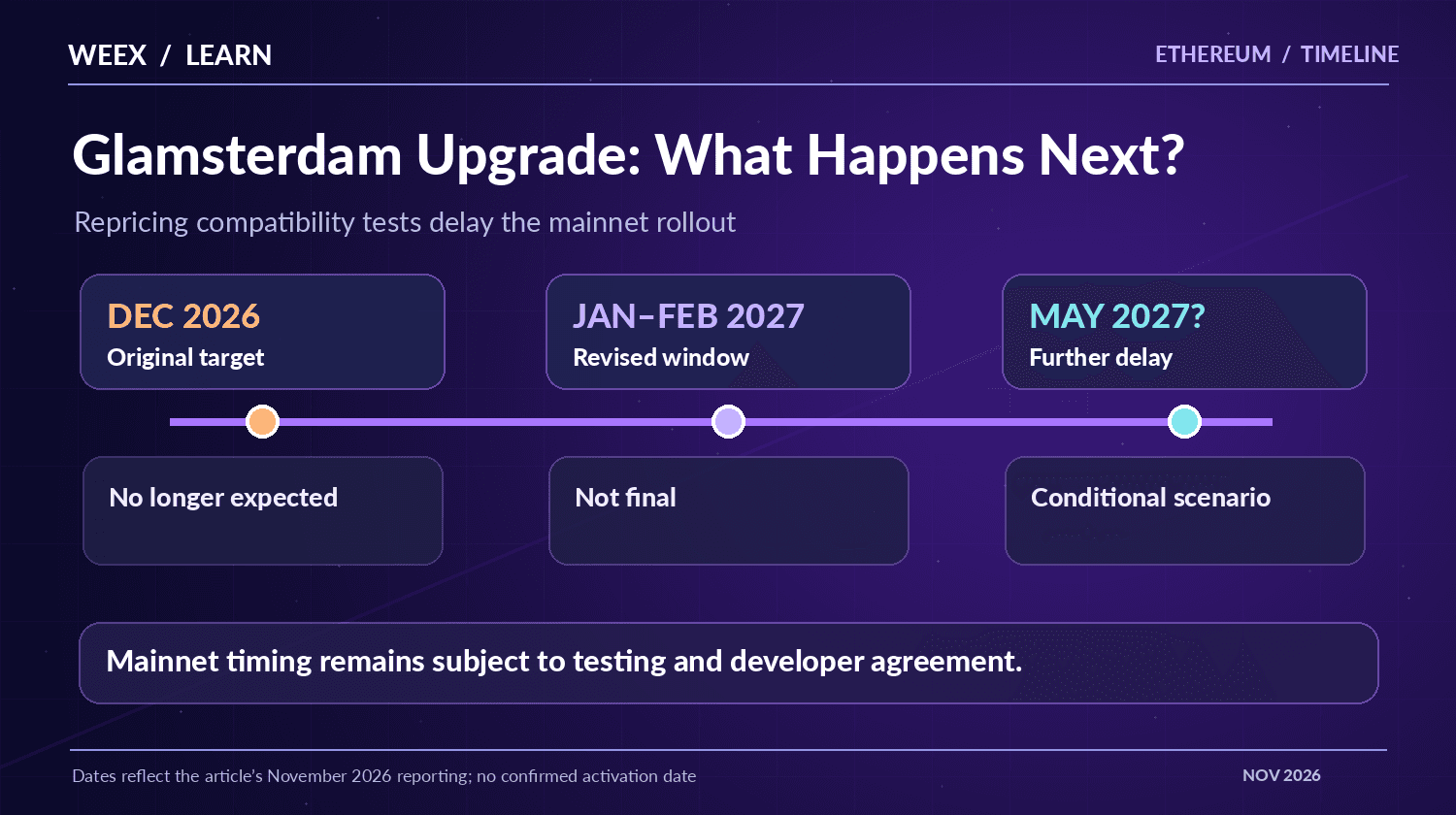
- Ethereum's Glamsterdam mainnet upgrade has moved beyond its original December 2026 target, with late January or early February 2027 now considered a more realistic window.
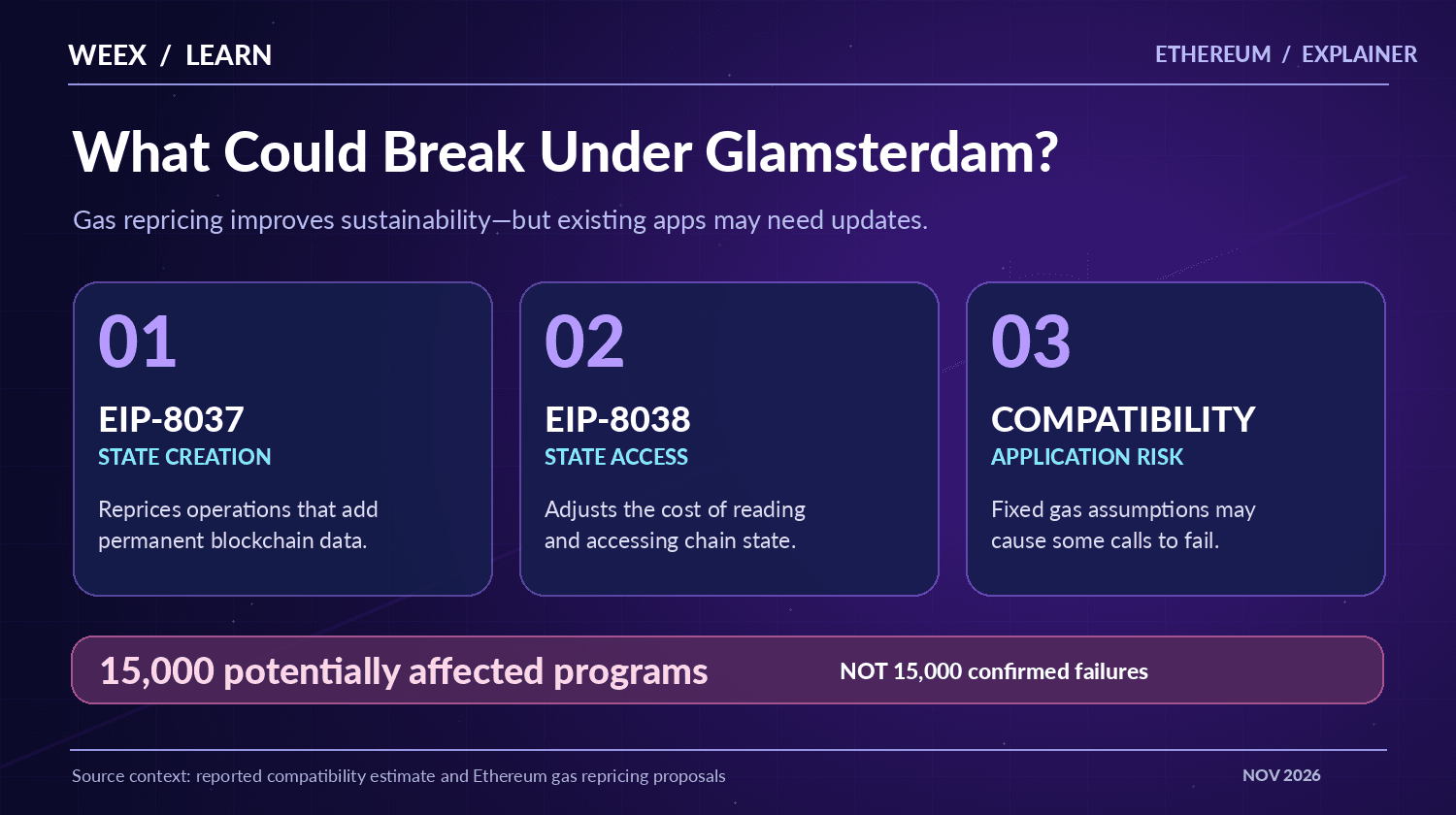
- Proposed gas repricing rules could affect up to 15,000 smart-contract programs, according to an Ethereum Foundation developer's estimate, although most applications are expected to remain compatible.
- EIP-8037 and EIP-8038 aim to make blockchain state creation and access more sustainable, but some existing contracts may require modifications.
- Further delays remain possible if developers revise the specifications, while any impact on ETH price depends on adoption, investor expectations and broader market conditions.
The Ethereum Glamsterdam upgrade is facing delays as developers address gas-pricing changes that could disrupt thousands of smart contracts. Originally targeted for December 2026, the Ethereum Glamsterdam upgrade is now expected no earlier than January 2027, with compatibility testing still underway. This article examines why the Ethereum Glamsterdam upgrade was postponed, which applications face potential risks and what the changes could mean for ETH.
Why Is Ethereum's Glamsterdam Upgrade Being Delayed?
Ethereum developers have postponed the expected launch of Glamsterdam, a major network upgrade designed to improve Layer 1 scalability and make blockchain resource accounting more sustainable.
According to discussions at the November 19, 2026 All Core Developers meeting, the upgrade is unlikely to activate before mid-January 2027. Late January or early February has emerged as a more realistic target, although developers have not established a final mainnet activation date.
The central concern involves changes to Ethereum's gas-pricing model. Glamsterdam includes proposals that increase the cost assigned to certain operations involving permanent blockchain data. While these adjustments are intended to support long-term scalability, some existing smart contracts assume that specific operations will always consume less than a fixed amount of gas.
If those assumptions no longer hold, a contract could run out of gas or encounter unexpected execution behavior after the upgrade.
Ethereum developers are therefore giving affected application teams additional time to review their code, test compatibility and implement fixes before the new protocol rules reach mainnet.
Ethereum Glamsterdam: Updated Timeline
| Milestone | Date or Status |
|---|---|
| Original Mainnet Target | December 2026 |
| Core Developers Discussion | November 19, 2026 |
| Earliest Reported Activation Window | Mid-January 2027 |
| More Realistic Launch Window | Late January to Early February 2027 |
| Proposed Hoodi Test | Week of December 14, 2026 |
| Next Test Decision | November 26, 2026 |
| Target for Urgent Application Fixes | Mid-December 2026 |
| Target for Other Identified Fixes | January 10, 2027 |
| Potentially Affected Programs | Up to approximately 15,000 |
| Final Mainnet Date | Not officially confirmed |
Sources: CoinDesk — Ethereum's Next Big Upgrade Is Pushed Into 2027, November 20, 2026; Ethereum Foundation — Glamsterdam Repricing Impact.
The proposed December test is particularly important because it could provide evidence that affected applications have successfully adapted to the new gas rules.
However, the November 26 developer discussion may still change the testing plan. The dates above represent the reported development schedule, not guaranteed activation milestones.
What Is the Ethereum Glamsterdam Upgrade?
Glamsterdam is a planned Ethereum network upgrade focused on improving execution capacity, block processing and long-term sustainability.
Ethereum's transaction and smart-contract activity requires network nodes to execute instructions, verify transactions and maintain an expanding database of account balances, contract code and stored information.
As network activity increases, more processing capacity becomes desirable. However, allowing significantly larger blocks without controlling permanent data growth could make independent node operation increasingly expensive.
Glamsterdam aims to address these challenges through multiple protocol improvements, including changes to how blocks are constructed and verified, how applications access state and how gas is charged for creating permanent blockchain data.
The objective is to increase Ethereum's capacity while managing the hardware requirements associated with operating the network.
Key Ethereum Glamsterdam Proposals
| Proposal | Main Function | Intended Benefit |
|---|---|---|
| EIP-7732 | Enshrined proposer-builder separation | Improve block production architecture |
| EIP-7928 | Block-level access lists | Support more efficient execution and validation |
| EIP-8037 | State creation gas repricing | Limit unsustainable permanent data growth |
| EIP-8038 | State access gas repricing | Better align charges with database processing costs |
| EIP-7954 | Increase maximum contract size | Support larger smart-contract applications |
Source: Ethereum.org — Glamsterdam Roadmap. Proposal inclusion and specifications remain subject to the network's final development process.
These improvements address different aspects of Ethereum's architecture. Some focus on how blocks are processed, while others adjust the economic cost of maintaining data.
The current implementation controversy is concentrated on gas repricing and its effects on applications developed under the existing cost assumptions.
-- Price
Why Could Glamsterdam Affect 15,000 Smart Contracts?
The estimate of approximately 15,000 potentially affected programs comes from an Ethereum Foundation developer's assessment discussed during the November developer meetings.
It does not mean that 15,000 contracts have already failed or will necessarily become unusable after activation.
Rather, the figure represents a potential compatibility problem that developers are investigating before deployment.
Smart contracts are programs that execute according to predefined rules. Some use fixed gas allowances, hardcoded thresholds or assumptions about how much computation a particular operation requires.
When the underlying protocol changes these costs, a transaction that previously succeeded may require a larger gas allowance or a modification to its execution logic.
How Gas Repricing Creates Compatibility Problems
Consider a contract that assumes a certain operation can be completed within a predefined gas limit.
Under the current network rules, that operation may execute successfully. After repricing, the same operation could consume more gas, causing the transaction to fail before completion.
For many applications, increasing the transaction's gas limit may resolve the problem. Other contracts, particularly those with deeply embedded assumptions or execution patterns that cannot easily be changed, may require more substantial modifications.
The Ethereum Foundation's testing indicates that the large majority of historical transactions remain unaffected.
However, even a comparatively small number of incompatible applications can justify delaying an upgrade when those applications support financial services, infrastructure or other important blockchain activity.
Which Ethereum Applications Could Be Affected?
| Application Type | Potential Compatibility Issue | Developer Response |
|---|---|---|
| DeFi Protocols | Fixed gas assumptions in contract calls | Test affected transactions |
| Smart-Contract Wallets | Insufficient gas allowances | Update execution logic |
| Cross-Chain Bridges | Gas-sensitive message processing | Review contract behavior |
| Token Deployment Tools | Higher state-creation requirements | Recalculate deployment costs |
| Automated Contract Systems | Hardcoded execution limits | Update and retest |
| Infrastructure Services | Outdated gas estimation | Revise software and simulation tools |
Source: Ethereum Foundation compatibility guidance. These are categories of potential exposure, not a confirmed list of affected protocols.
According to CoinDesk's November 20 reporting, Ethereum developers and security researchers had contacted more than 50 affected companies to coordinate remediation.
The preparation work highlights why a technically ambitious upgrade must also account for software that already exists across the network.
Why Are Ethereum Gas Costs Changing?
Ethereum uses gas to measure the resources required to process blockchain operations.
However, not all operations impose the same burden on the network.
A calculation may consume processing resources temporarily, while creating a new account or storage slot adds information that nodes may need to maintain indefinitely.
Glamsterdam's repricing proposals attempt to reflect these different costs more accurately.
EIP-8037: Higher Charges for State Creation
EIP-8037 introduces a new framework for charging applications when they create permanent blockchain state.
The proposal ties certain costs to the amount of state created, rather than relying entirely on older fixed-price assumptions.
According to the Ethereum Foundation, the mechanism targets sustainable state database growth of approximately 120 GiB annually under its reference model.
The proposal also separates certain state-related charges from ordinary execution gas accounting.
This design is intended to allow Ethereum to process more transactions without making permanent storage requirements grow uncontrollably.
EIP-8038: Repricing State Access
EIP-8038 addresses the cost of retrieving and interacting with information already stored on Ethereum.
As Ethereum's database expands, reading particular state entries can require more work from network nodes.
Some operations have historically been priced below the resources they consume, potentially creating efficiency and security concerns.
By adjusting these costs, Ethereum developers aim to support a more sustainable relationship between network throughput and node requirements.
However, changing operation prices can also affect applications designed around the existing gas schedule.
How Much Could Smart-Contract Creation Costs Increase?
One frequently discussed example involves the base state-related charge associated with creating a new smart contract.
Reports on the proposed changes indicate that this charge could rise from approximately 32,000 to 183,600 gas units, with additional charges applying to other elements of contract execution and storage.
| Metric | Existing Reference | Proposed Reference |
|---|---|---|
| Contract-Creation Base Charge Discussed | 32,000 gas | 183,600 gas |
| Additional Storage Costs | Existing gas rules | Separately accounted charges |
| State-Creation Pricing | Existing operation costs | Revised EIP-8037 framework |
| Main Objective | Current network operation | More sustainable scaling |
| Main Compatibility Concern | Existing gas assumptions | Potential contract failures |
Sources: CoinDesk, November 20, 2026; Ethereum EIP-8037 specification.
These figures illustrate a particular protocol-level charge, not the total fee every Ethereum user will pay.
Actual transaction fees depend on gas consumption, prevailing gas prices and application behavior.
Therefore, it would be incorrect to conclude that all ETH transfers or decentralized application transactions will become proportionally more expensive.
Could Glamsterdam Be Delayed Until May 2027?
A further delay remains possible if Ethereum developers decide to revise the proposed gas-pricing specifications instead of proceeding with the current design.
According to November 19–20 reporting, a major revision could push the upgrade into a later development and testing cycle, potentially extending the timeline as far as May 2027.
However, May is a conditional scenario rather than an officially confirmed activation date.
What Happens Next?
The immediate priority is determining whether affected applications can be made compatible while keeping the current repricing proposals intact.
Developers supporting the existing design argue that preserving the planned specifications would avoid further disruption to the broader upgrade schedule.
Others have raised concerns that the new gas-accounting assumptions could introduce unacceptable compatibility risks.
The outcome will depend on testing results, the number and severity of remaining issues, and whether client developers can reach sufficient agreement on the final implementation.
Possible Glamsterdam Upgrade Scenarios
| Scenario | Possible Timeline | Main Consideration |
|---|---|---|
| Current Rules Retained | Late January–Early February 2027 | Affected applications complete fixes |
| Additional Testing Needed | Later in 2027 | Compatibility issues remain unresolved |
| Major Gas Specification Revision | Potentially as late as May 2027 | More extensive redesign and testing |
| Successful Mainnet Activation | Date not confirmed | Final rules deployed after testing |
Source: Scenario analysis based on reported developer discussions. Dates beyond the immediate reported schedule are possibilities, not commitments.
Investors should follow official Ethereum development updates rather than assuming any single proposed activation window is final.
Will the Glamsterdam Delay Affect ETH Price?
Network upgrades can influence cryptocurrency market sentiment, but their effects on token prices are rarely straightforward.
A successful Glamsterdam deployment could support Ethereum's long-term competitiveness if improvements to block processing and resource accounting enable greater network activity.
However, investors must distinguish potential technical benefits from actual economic demand for ETH.
A delay may create uncertainty around the development roadmap, particularly if important applications require additional testing or modifications.
Conversely, postponing activation to prevent technical failures could strengthen confidence in Ethereum's approach to network security and reliability.
What Should ETH Investors Monitor?
Developer consensus: Progress toward agreement on the final gas-pricing specifications will help determine the reliability of the next proposed activation window.
Application compatibility: Successful testing by affected wallets, decentralized applications and infrastructure providers would reduce implementation uncertainty.
Network usage: Long-term token demand depends partly on actual Ethereum activity, including transactions, decentralized applications and settlement services.
Market conditions: ETH remains exposed to cryptocurrency liquidity, derivatives positioning and broader investor risk appetite.
The upgrade itself does not guarantee higher ETH prices, lower transaction fees or increased network usage.
For additional context, see WEEX's analysis of Vitalik Buterin's Support for Ethereum Gas Fee Reform.
Readers can also review the earlier Ethereum Glamsterdam Upgrade and ETH Price Impact Guide.
Do ETH Holders Need to Take Action Before Glamsterdam?
Ordinary ETH holders generally do not need to migrate their tokens merely because Glamsterdam is being prepared.
The upgrade concerns Ethereum's protocol operations rather than introducing a replacement cryptocurrency.
Developers and infrastructure providers have more specific preparation requirements.
Applications that rely on hardcoded gas assumptions should be tested against the proposed changes, while wallet providers and other services may need to update their software.
Users should also be cautious of websites claiming that a network upgrade requires transferring ETH to a special address or revealing recovery phrases.
Official network upgrades do not require users to disclose private keys.
How to Buy or Trade Ethereum (ETH) on WEEX
WEEX provides ETH spot trading and USDT-margined perpetual futures, allowing eligible users to access Ethereum-related markets under different product structures.
Step 1: Open the ETH Trading Market
Visit the WEEX ETH/USDT Spot Trading Page to review the current quotation, available liquidity and order types.
Users interested in derivatives can separately access the WEEX ETHUSDT Perpetual Futures Market.
Step 2: Prepare USDT and Review Trading Conditions
Sign in to WEEX, complete applicable verification requirements and prepare the necessary USDT balance.
For spot trading, review the ETH quantity, order type and transaction fees.
For perpetual futures, check leverage, margin requirements, funding rates and liquidation conditions.
Step 3: Place an Order and Monitor Risk
Confirm the intended order quantity and execution conditions before submitting the trade.
Ethereum-related markets may experience volatility around protocol upgrades, macroeconomic developments and broader cryptocurrency market movements.
Perpetual futures introduce additional risks because leverage can amplify both gains and losses.
Users can also consult the WEEX Ethereum Price Information Page for further asset information.
Conclusion
The Ethereum Glamsterdam upgrade has moved into 2027 as developers address smart-contract compatibility risks associated with proposed gas repricing. The delay reflects the importance of testing changes that could affect existing applications, even when the broader objective is to improve network scalability.
The Ethereum Glamsterdam upgrade could eventually support more sustainable blockchain growth, but its final activation date remains uncertain. A potential delay into May 2027 should be treated as a conditional scenario rather than a confirmed schedule.
For ETH investors, the Ethereum Glamsterdam upgrade is an important technical milestone, but future market performance will depend on actual implementation, developer adoption, network activity and broader market conditions.
FAQ
1. When will Ethereum's Glamsterdam upgrade launch?
Glamsterdam is not expected to activate before mid-January 2027, with late January or early February considered a more realistic window in November developer discussions. A further delay remains possible, but no final mainnet activation date has been confirmed.
2. Could Glamsterdam really affect 15,000 smart contracts?
An Ethereum Foundation developer estimated that up to approximately 15,000 programs could face compatibility problems under the proposed changes. This is a potential impact estimate, not a confirmed count of failed contracts. Many issues may be resolved through updated gas limits or software modifications.
3. Will Ethereum gas fees increase after Glamsterdam?
Some operations involving permanent blockchain state may become more expensive in gas terms. However, the changes do not impose a uniform fee increase on every ETH transfer or application transaction. Actual costs depend on the operation, gas pricing and transaction behavior.
4. Could the Glamsterdam upgrade be delayed until May 2027?
Yes, this is a possible scenario if developers decide to make substantial changes to the gas-pricing specifications. However, May 2027 is not an officially confirmed activation date, and the timeline depends on future development decisions and testing results.
5. Can users trade ETH on WEEX during network upgrade uncertainty?
WEEX provides ETH spot trading and perpetual futures, subject to product availability. Users should monitor official network and exchange announcements, review relevant trading conditions and understand the additional risks associated with leveraged derivatives.
This content is provided for general informational purposes only and doesn't constitute financial, investment, legal, or tax advice. Any events, rewards, online promotions, or related information mentioned herein should not be considered a recommendation, solicitation, or invitation to purchase, sell, trade, or otherwise deal in any crypto assets. Crypto assets are highly volatile and may result in loss. The availability of WEEX services, products, and related events may vary by region. You are responsible for ensuring that your participation is in accordance with applicable local laws and regulations.
You may also like
View moreBinance Hack: Can the DOJ Recover $1.1B in Frozen USDC?
Beginner9 minWEEX Product GuideNVIDIA Rehires Jensen Huang Just 11 Days Later: What Changed Behind the Scenes?
Beginner7 minWEEX Product GuideXLM Price Drops 2.48% Before Stellar's Bell Vote: Can Protocol 30 Change the Trend?
Beginner8 minWEEX Product GuideTether Backs SCRYPT: Could USDT Become the New Rail for Global Payments?
Beginner6 minWEEX Product GuidePolygon's Purley Hard Fork Is Live: What Changes for POL and Network Security?
Beginner7 minWEEX Product GuideCoherent and Lumentum Stocks Rise: Why Optical Stocks Are Rallying
Beginner7 minWEEX Product Guide


